
Sine Wave on Sphere
Loading the math board and drawing, please wait…
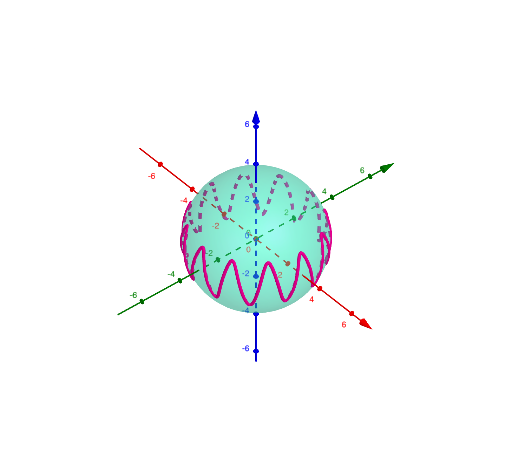
This example demonstrates the generation of a sine wave on a sphere, illustrating the geometric shape of function graphs in three-dimensional space. Core mathematical concepts include trigonometry, solid geometry, integral calculus, and parametric equations. Key construction points involve GeoGebra commands such as Intersect, Sphere, and CurveCartesian, utilizing objects like a, A, b, n, c, d. Suitable for high school and above learners to understand the integration of spatial geometry and function graphs, as well as the application of parametric modeling.
GeoGebra Commands & Parameters
Intersect(zAxis, xAxis) → ASphere(A, a) → bCurveCartesian(((a^(2) - (c^(2) * (cos((n * t)))^(2)))^(1 / 2) * cos(t)), ((a^(2) - (c^(2) * (cos((n * t)))^(2)))^(1 / 2) * sin(t)), (c * cos((n * t))), t, 0, (2 * π)) → d
AI Drawing Prompt Reference
Draw a sphere in 3D, then place a sine-wave shaped curve on its surface. First, take the intersection point of a vertical axis and a horizontal axis through the origin. Use this point as the center to construct the sphere with the given radius parameter. Next, create a parametric curve for t from 0 to 2π on the sphere: the x–y direction is governed by cos(t) and sin(t), while the vertical component is given by c·cos(n t). The horizontal scale is set by the square root of a^2−c^2 cos^2(n t), producing the sine-like geometric wave distribution on the spherical surface.
The prompt above was compiled from the original drawing commands and is for reference only.