
Surface Area of Spheres with Proof: GeoGebra Solid Construction
Loading the math board and drawing, please wait…
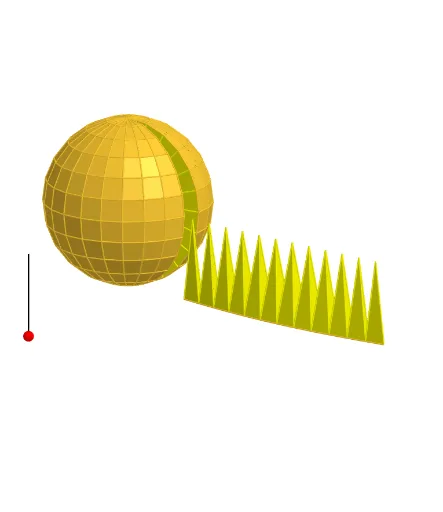
This example demonstrates the surface area of spheres through a proof-guided visualization: it builds a sphere using geometric symmetry and constructive transformations, helping learners understand why the classic surface-area formula holds. Key mathematical ideas include solid geometry of a sphere and its surface area, symmetry via orthogonal planes, and spatial transformations (rotation, reflection, translation) to replicate a defining profile around an axis. The construction uses Line and Sequence to generate guiding lines and point sequences, Segment and Point to define key vertices, and If to control conditional point placement and logic for the build. It then applies Rotate, Translate, and Mirror to create the replicated surface pieces and related auxiliary geometries (assembled via polygon-like objects such as poly1, poly2, poly3). A Sphere object provides the target 3D reference, while OrthogonalPlane supplies a perpendicular slicing/organizing plane. List-based objects (e.g., list1/list1', list2/list2', and their primed variants) support structured construction or discrete approximations that connect geometric “area accumulation” with the proof strategy. Suitable for high school advanced geometry through early university calculus preparation and classroom demonstrations of sphere-surface area reasoning.
GeoGebra Commands & Parameters
Line((0, 0, 1), (0, 1, 1)) → cSequence(Rotate[(0, 0, 0), (-(((i * 15))°)), c], i, 0, 6) → list1Rotate(list1, 15°, zAxis) → list1'Line(Element[list1, 2], Element[list1', 2]) → l1Line((0, 0, 0), l1) → l0Sequence(Polygon[Element[list1, i], Element[list1', i], Element[list1', i + 1], Element[list1, i + 1]], i, 1, 6) → list2Segment(A, A + (0, 0, 1)) → aPoint(a) → PIf(z(P) ≥ 0.5, 0, (2 * (0.5 - z(P)))) → tIf(z(P) ≥ 0.5, (2 * (1 - z(P))), 1) → sTranslate(list2, Vector[(s * Vector[(0, 0, 0), (1, 0, 0)])]) → list2'Translate(l0, Vector[(s * Vector[(0, 0, 0), (1, 0, 0)])]) → l0'Sphere((0, 0, 1), 1) → bSequence(Pyramid[Element[list2, i], (0, 0, 1)], i, 1, 6) → list3Translate(list3, Vector[(s * Vector[(0, 0, 0), (1, 0, 0)])]) → list3'Line(Element[list1, 3], Element[list1', 3]) → l2Line(Element[list1, 4], Element[list1', 4]) → l3Line(Element[list1, 5], Element[list1', 5]) → l4Line(Element[list1, 6], Element[list1', 6]) → l5Line(Element[list1, 7], Element[list1', 7]) → l6Rotate(Element[list3', 1], (t * 7.5°), l0') → dTranslate(l1, Vector[(s * Vector[(0, 0, 0), (1, 0, 0)])]) → l1'Translate(l2, Vector[(s * Vector[(0, 0, 0), (1, 0, 0)])]) → l2'Translate(l3, Vector[(s * Vector[(0, 0, 0), (1, 0, 0)])]) → l3'Translate(l4, Vector[(s * Vector[(0, 0, 0), (1, 0, 0)])]) → l4'Rotate(l1', (7.5° * t), l0') → l1''Rotate(Rotate[Element[list3', 2], (t * 7.5°), l0'], (t * 15°), l1'') → eRotate(Rotate[l2', (t * 7.5°), l0'], (t * 15°), l1'') → l2''Rotate(Rotate[Rotate[Element[list3', 3], (t * 7.5°), l0'], (t * 15°), l1''], (t * 15°), l2'') → fRotate(Rotate[Rotate[l3', (t * 7.5°), l0'], (t * 15°), l1''], (t * 15°), l2'') → l3''Rotate(Rotate[Rotate[Rotate[Element[list3', 4], (t * 7.5°), l0'], (t * 15°), l1''], (t * 15°), l2''], (15° * t), l3'') → gRotate(Rotate[Rotate[Rotate[l4', (t * 7.5°), l0'], (t * 15°), l1''], (t * 15°), l2''], (t * 15°), l3'') → l4''Rotate(Rotate[Rotate[Rotate[Rotate[Element[list3', 5], (t * 7.5°), l0'], (t * 15°), l1''], (t * 15°), l2''], (15° * t), l3''], (15° * t), l4'') → hTranslate(l5, Vector[(s * Vector[(0, 0, 0), (1, 0, 0)])]) → l5'Rotate(Rotate[Rotate[Rotate[Rotate[l5', (t * 7.5°), l0'], (t * 15°), l1''], (t * 15°), l2''], (t * 15°), l3''], (15° * t), l4'') → l5''Rotate(Element[list2', 1], (t * 7.5°), l0') → poly1Rotate(Rotate[Rotate[Rotate[Rotate[Rotate[Element[list3', 6], (t * 7.5°), l0'], (t * 15°), l1''], (t * 15°), l2''], (15° * t), l3''], (15° * t), l4''], (15° * t), l5'') → iRotate(Rotate[Element[list2', 2], (t * 7.5°), l0'], (t * 15°), l1'') → poly2Rotate(Rotate[Rotate[Element[list2', 3], (t * 7.5°), l0'], (t * 15°), l1''], (t * 15°), l2'') → poly3Rotate(Rotate[Rotate[Rotate[Element[list2', 4], (t * 7.5°), l0'], (t * 15°), l1''], (t * 15°), l2''], (15° * t), l3'') → poly4Rotate(Rotate[Rotate[Rotate[Rotate[Element[list2', 5], (t * 7.5°), l0'], (t * 15°), l1''], (t * 15°), l2''], (15° * t), l3''], (15° * t), l4'') → poly5Rotate(Rotate[Rotate[Rotate[Rotate[Rotate[Element[list2', 6], (t * 7.5°), l0'], (t * 15°), l1''], (t * 15°), l2''], (15° * t), l3''], (15° * t), l4''], (15° * t), l5'') → poly6OrthogonalPlane((0, 0, 1), zAxis) → mTranslate(l6, Vector[(s * Vector[(0, 0, 0), (1, 0, 0)])]) → l6'Rotate(Rotate[Rotate[Rotate[Rotate[Rotate[l6', (t * 7.5°), l0'], (t * 15°), l1''], (t * 15°), l2''], (t * 15°), l3''], (15° * t), l4''], (15° * t), l5'') → l6''Rotate(Rotate[Rotate[Rotate[Rotate[Rotate[Rotate[m, (t * 7.5°), l0'], (t * 15°), l1''], (t * 15°), l2''], (15° * t), l3''], (15° * t), l4''], (15° * t), l5''], (7.5° * t), l6'') → nMirror(i, n) → i'Mirror(h, n) → h'Mirror(g, n) → g'Mirror(f, n) → f'Mirror(e, n) → e'Mirror(d, n) → d'Mirror(poly6, n) → poly6'Mirror(poly5, n) → poly5'Mirror(poly4, n) → poly4'Mirror(poly3, n) → poly3'Mirror(poly2, n) → poly2'Mirror(poly1, n) → poly1'Sequence(Rotate[list3, 15° + ((15° * 22) * i), zAxis], i, 0, 1) → list4Mirror(list4, m) → list4'Sequence(Rotate[list2, (15° * i), zAxis], i, 1, 23) → list5Mirror(list5, m) → list5'
AI Drawing Prompt Reference
Visualize the surface area of a sphere with a proof. Start by rotating a line segment to create a series of symmetric lines, then use these to construct multiple triangles that approximate the sphere's surface. Rotate and translate these triangles around the axis to form pyramids, which together resemble the sphere. Finally, further rotate and translate these pyramids while using a plane perpendicular to the axis to demonstrate how the surface area is formed, aiding in understanding the formula derivation.
The prompt above was compiled from the original drawing commands and is for reference only.