
Step-by-Step Volume by Shells Method
Loading the math board and drawing, please wait…
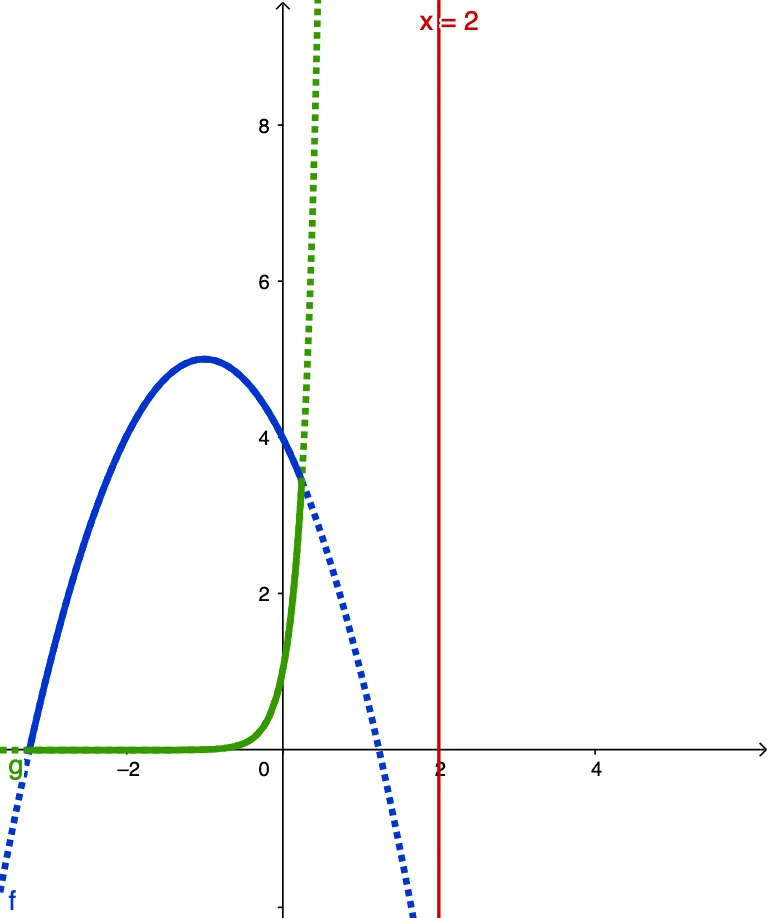
① This example demonstrates the volume-by-shells (cylindrical shells) method for computing volumes of solids of revolution through a step-by-step animated visualization, showing the function curves, the solid, and the construction of shell thickness and radius. ② The core mathematical concept is integral calculus, specifically the shell method formula V = 2π∫(radius × height) dx, involving functions, interval partitioning, Riemann sums, and the limit process. ③ Construction details: uses GeoGebra commands such as LaTeX for formula display, Point and Segment to create key points and segments, and Mirror to generate symmetric parts; objects include functions f and g, leftBound and rightBound, slider 'steps' to control the number of partitions, stepMax and back/forward buttons for stepwise navigation, list1 storing the shells, A, B, h, r representing height and radius, fcut/gcut for truncated function segments, fshadow/gshadow for shadows, and text objects for explanatory labels. ④ Suitable for high school seniors or early college calculus students to grasp the geometric intuition and numerical approximation of volumes, and also useful for classroom demonstrations by teachers.
GeoGebra Commands & Parameters
LaTeX(("\text{step }" * steps)) → text1LaTeX("\text{The general form of the integrand is } 2\pi(radius)(height)\text{.}") → text3Point(xAxis) → ASegment((x(A), g(x(A))), (x(A), f(x(A)))) → hPoint(h) → BSegment(B, (2, y(B))) → rLaTeX("\text{In this case the radius is given by }\textcolor{#FF33CC}{r}=x-\textcolor{#CC0000}{2}\text{.}") → text4LaTeX("\text{The integration limits come from the x-coordinates of the}\cr\text{intersection points of functions }\textcolor{#000099}{f}\text{ and }\textcolor{#339900}{g}.") → text6LaTeX((((((("\text{Use cylindrical shells to calculate the volume swept out when the}\cr\text{region enclosed by the functions }\textcolor{#0033CC}{f=" * f) * "}\text{ and }\textcolor{#339900}{g=e^{") * a) * "x}}\text{ is}\cr\text{revolved around the line }\textcolor{#CC0000}{") * c) * "}.")) → text2LaTeX("\text{The height }\textcolor{#FF6600}{h}\text{ is given by }\textcolor{#0033CC}{f(x)}-\textcolor{#339900}{g(x)}.") → text5LaTeX((((((((("V=2\pi\int_{" * Lintersect) * "}^{") * Rintersect) * "}(x-2)\left[(") * f) * ")-(") * g) * ")\right]dx")) → text7Mirror(fcut, c) → fshadowMirror(gcut, c) → gshadowMirror(h, c) → h'Mirror(r, c) → r'
AI Drawing Prompt Reference
Create an animated visualization demonstrating the cylindrical shells method for calculating volumes of solids of revolution. Show function curves, the solid, and the construction of shell thickness and radius. Use a slider to control the number of partitions and buttons for stepwise navigation. Display the integral formula V = 2π∫(radius × height) dx, where the radius is x-2 and the height is f(x)-g(x), with f(x) and g(x) being blue and green functions respectively. Represent the rotation axis with a red line, and indicate the integration limits and shaded areas.
The prompt above was compiled from the original drawing commands and is for reference only.