
Star Trajectory Exploration
Loading the math board and drawing, please wait…
In collections
Regular Polygons
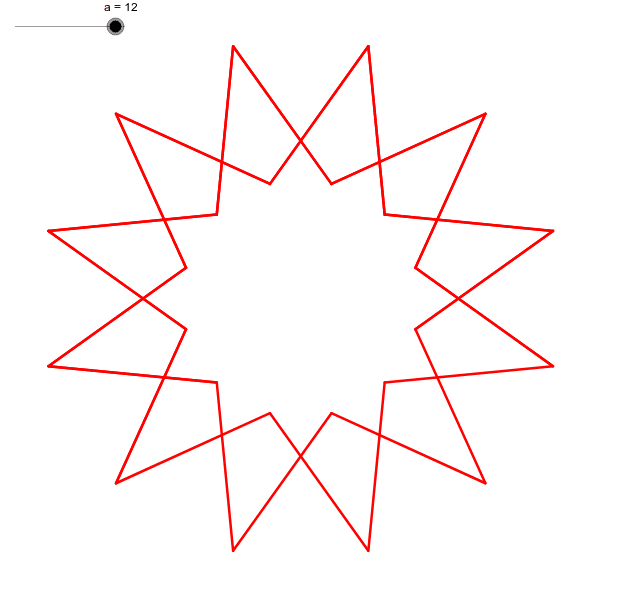
This example demonstrates the trajectory of a star under specific conditions, exploring the continuous trajectory of a single star and the overlap of two stars' trajectories. Key mathematical concepts include geometric transformations and loci. Using commands like Rotate, Mirror, and Polygon in GeoGebra, complex geometric shapes can be constructed. Suitable for high school students and math enthusiasts.
GeoGebra Commands & Parameters
Intersect(xAxis, yAxis) → ACircle(A, u) → c_3Intersect(c_3, yAxis) → B, CRotate(B, 360 * ° / (2 * a), A) → B'Mirror(B', yAxis) → B''Polygon(B'', B', a) → poly1, b_3, l_2, m, n, D, E, F, G, H, I, J, d_3, K, L, M, e_3, f_3, g_3, h_3, i_3, j_3, k_2Dilate(poly1, o, A) → poly1'Dilate(c_3, o, A) → c'Ray(A, E) → dRay(A, F) → eRay(A, G) → fRay(A, B'') → bRay(A, B') → cRay(A, D) → a_1Intersect(c', d) → N,Intersect(c', b) → O,Intersect(c', e, 1) → PIntersect(c', f, 1) → QIntersect(c', c, 1) → RIntersect(c', a_1, 1) → SRay(A, H) → gRay(A, I) → hRay(A, J) → iRay(A, K) → jRay(A, L) → kRay(A, M) → lIntersect(c', g, 1) → TIntersect(c', h, 1) → UIntersect(c', i, 1) → VIntersect(c', j, 1) → WIntersect(c', k, 1) → ZIntersect(c', l, 1) → A_1Polygon(O, R, a) → poly2, h_1, j_2, s_1, e_2, B_1, C_1, D_1, E_1, F_1, G_1, H_1, i_1, I_1, J_1, K_1, j_1, k_1, l_1, m_1, g_2, h_2, i_2Segment(F, N) → n_1Segment(N, D) → p_1Segment(D, R) → q_1Segment(R, B'') → r_1Segment(Q, F) → t_1Segment(P, E) → a_2Segment(E, S) → b_2Segment(S, B') → c_2Segment(B', O) → d_2Segment(G, P) → f_2Segment(K_1, B'') → pSegment(M, O) → qSegment(K_1, L) → rSegment(M, Z) → sSegment(L, I_1) → tSegment(Z, K) → b_1Segment(K, V) → c_1Segment(I_1, J) → d_1Segment(J, U) → e_1Segment(V, I) → f_1Segment(I, T) → g_1Segment(U, H) → m_2Segment(H, Q) → n_2Segment(G, T) → p_2Segment(S, B'') → q_2Segment(O, D) → r_2Mirror(N, d) → N'Mirror(D, d) → D'Segment(N', D') → s_2Mirror(E, d) → E'Mirror(S, d) → S'Segment(E', S') → t_2Mirror(F, e) → F'Mirror(N, e) → N'_1Segment(F', N'_1) → a_3Mirror(E', e) → E''Mirror(S', e) → S''Segment(E'', S'') → k_3Mirror(E'', f) → E'''Mirror(S'', f) → S'''Segment(E''', S''') → l_3Mirror(F', f) → F''Mirror(N'_1, f) → L_1Segment(F'', L_1) → m_3Mirror(F'', g) → F'''Mirror(L_1, g) → M_1Segment(F''', M_1) → n_3Mirror(G, g) → G'Mirror(T, g) → T'Segment(G', T') → p_3Mirror(I, h) → I'Mirror(T, h) → T'_1Segment(I', T'_1) → q_3Mirror(U, h) → U'Mirror(H, h) → H'Segment(U', H') → r_3Mirror(J, i) → J'Mirror(U, i) → U'_1Segment(J', U'_1) → s_3Mirror(V, i) → V'Mirror(I, i) → I'_1Segment(V', I'_1) → t_3Mirror(K, j) → K'Mirror(V, j) → V'_1Segment(K', V'_1) → a_4Mirror(I_1, j) → N_1Mirror(J, j) → J'_1Segment(N_1, J'_1) → b_4Mirror(L, k) → L'Mirror(I_1, k) → O_1Segment(L', O_1) → t'Mirror(Z, k) → Z'Mirror(K, k) → K'_1Segment(Z', K'_1) → c_4
AI Drawing Prompt Reference
Draw a star trajectory exploration diagram, starting with a circle c_3 centered at A, intersecting the y-axis at points B and C. Use rotation, mirroring, and polygon commands to construct B' and B''. Then, apply scaling and intersection commands to create c', d, e, f, b, c, a_1, and points N, O, P, Q, R, S, T, U, V, W, Z, and A_1. Finally, use the polygon command to create poly2.
The prompt above was compiled from the original drawing commands and is for reference only.