
Explore Frieze Symmetry
Loading the math board and drawing, please wait…
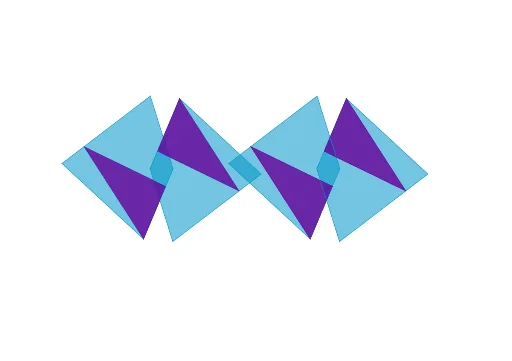
This example explores frieze symmetry by controlling the gyration point. It demonstrates the concepts of rotation and symmetry, using commands like Circle, Rotate, and Polygon in GeoGebra. Suitable for middle school and above students learning geometric transformations.
GeoGebra Commands & Parameters
Circle(A, B) → cRotate(B, α, A) → B'Rotate(B, (-α), A) → B'_1Polygon(A, B', B, B'_1) → q1, a, b', b, b'_1Midpoint(a) → CMidpoint(b) → DMidpoint(A, C) → EMidpoint(C, B') → FMidpoint(B'_1, D) → GMidpoint(D, B) → HPolygon(E, B'_1, G, H) → q2, e, f, g, hRotate(A, 180°, I) → A'Rotate(B', 180°, I) → B''Rotate(B, 180°, I) → B'_2Rotate(B'_1, 180°, I) → JPolygon(A', B'', B'_2, J) → q1', a', b'', b'_2, jRotate(E, 180°, I) → E'Rotate(B'_1, 180°, I) → KRotate(G, 180°, I) → G'Rotate(H, 180°, I) → H'Polygon(E', K, G', H') → q2', e', k, g', h'Circle(A_1, B_1) → c_1Rotate(B_1, α_1, A_1) → B'_3Rotate(B_1, (-α_1), A_1) → B'_4Polygon(A_1, B'_3, B_1, B'_4) → q1_1, a_1, b'_3, b_1, b'_4Midpoint(a_1) → C_1Midpoint(b_1) → D_1Midpoint(A_1, C_1) → E_1Midpoint(C_1, B'_3) → F_1Midpoint(B'_4, D_1) → G_1Midpoint(D_1, B_1) → H_1Polygon(E_1, B'_4, G_1, H_1) → q2_1, e_1, f_1, g_1, h_1Rotate(A_1, 180°, I_1) → A'_1Rotate(B'_3, 180°, I_1) → B''_1Rotate(B_1, 180°, I_1) → B'_5Rotate(B'_4, 180°, I_1) → J_1Polygon(A'_1, B''_1, B'_5, J_1) → q1'_1, a'_1, b''_1, b'_5, j_1Rotate(E_1, 180°, I_1) → E'_1Rotate(B'_4, 180°, I_1) → K_1Rotate(G_1, 180°, I_1) → G'_1Rotate(H_1, 180°, I_1) → H'_1Polygon(E'_1, K_1, G'_1, H'_1) → q2'_1, e'_1, k_1, g'_1, h'_1Vector(A, A + (spacing, 0)) → uTranslate(I, u) → I'Translate(I_1, u) → LTranslate(A, u) → A'_2Translate(B', u) → B''_2Translate(B, u) → B'_6Translate(B'_1, u) → MPolygon(A'_2, B''_2, B'_6, M) → q1'_2, a'_2, b''_2, b'_6, m_2Translate(A', u) → A''Translate(B'', u) → B'''Translate(B'_2, u) → NTranslate(J, u) → J'Polygon(A'', B''', N, J') → q1'', a'', b''', n_2, j'Translate(A_1, u) → OTranslate(B'_3, u) → PTranslate(B_1, u) → QTranslate(B'_4, u) → RPolygon(O, P, Q, R) → q3, o, p, q, rTranslate(A'_1, u) → STranslate(B''_1, u) → TTranslate(B'_5, u) → UTranslate(J_1, u) → VPolygon(S, T, U, V) → q4, s, t, u_1, vTranslate(E, u) → E'_2Translate(B'_1, u) → WTranslate(G, u) → G'_2Translate(H, u) → H'_2Polygon(E'_2, W, G'_2, H'_2) → q2'_2, e'_2, w, g'_2, h'_2Translate(E', u) → E''Translate(K, u) → K'Translate(G', u) → G''Translate(H', u) → H''Polygon(E'', K', G'', H'') → q2'', e'', k', g'', h''Translate(E_1, u) → ZTranslate(B'_4, u) → L_1Translate(G_1, u) → M_1Translate(H_1, u) → N_1Polygon(Z, L_1, M_1, N_1) → q5, z_1, l_1, i, lTranslate(E'_1, u) → O_1Translate(K_1, u) → P_1Translate(G'_1, u) → Q_1Translate(H'_1, u) → R_1Polygon(O_1, P_1, Q_1, R_1) → q6, o_1, p_1, q_1, r_1