
Geometric construction with circles, reflection, angle bisectors, and polygon fo
Loading the math board and drawing, please wait…
In collections
Poorly Drawn Parallelograms 3
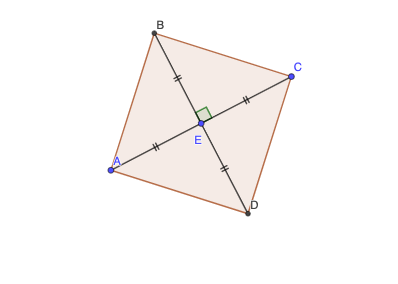
This example demonstrates how to build a constrained geometric configuration using a circle together with reflection (mirror symmetry) and angle bisectors. By constructing reflected elements, finding intersections, and connecting key points, the model forms a polygon whose structure reveals the underlying angle and symmetry relationships. The main concepts include circle geometry, mirror symmetry, the angle-bisector principle (LineBisector), intersection construction (Intersect), and polygon formation from a sequence of constructed points (Polygon/Segment). In GeoGebra it is implemented with Circle to define the circle, Mirror to reflect points/objects across a chosen line or object, LineBisector to create the bisector that controls the angle relationship, Intersect to locate critical intersection points, and Polygon/Segment to connect points and visualize edges; Angle/α are used to mark or analyze the resulting angle connections. Suitable for secondary-school geometry instruction and for learners practicing geometric construction and reasoning with symmetry and angle bisectors.
GeoGebra Commands & Parameters
Circle(E, A) → cMirror(A, E) → CLineBisector(A, C) → fIntersect(c, f, 2) → BIntersect(c, f, 1) → DPolygon(A, B, C, D) → q1, b, c_1, b', dSegment(A, E) → gSegment(E, B) → hSegment(E, C) → iSegment(E, D) → jAngle(C, E, B) → α
AI Drawing Prompt Reference
Draw a circle, reflect a point across a line through another point on the circle, then construct the angle bisector of the angle formed by these two points. Find the intersections of the angle bisector with the circle to get two points. Connect these four points to form a quadrilateral, and draw line segments connecting the reflected point to the original point and the other two intersection points on the circle. Label the angle between the reflected point, the original point, and the angle bisector.
The prompt above was compiled from the original drawing commands and is for reference only.