
Are All Parabolas Similar? A Geometry Check with Parameters
Loading the math board and drawing, please wait…
In collections
Conic Section Collection
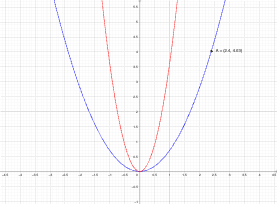
This GeoGebra example visually demonstrates that the statement “all parabolas are similar” is not generally true: different parameter choices can change the parabolas’ shape in ways that cannot be matched by a single similarity transformation. The key math ideas are parabolic parameter dependence, similarity criteria (how parameters control the opening/scale), and geometric reasoning using transformations and constructed reference configurations. Construction-wise, it relies on GeoGebra’s polygon-based scaffolding via the command Polygon to build auxiliary geometric structures, then uses multiple coordinated objects (such as sets of points and labels like a, b, c, d, g1, g2, A/B/C/D, q1/q2, and the grouped variants b1/c1/a1/d1, plus points like x1 and text labels such as text1/text2) to compare the resulting shapes and highlight when similarity does or does not hold. Suitable for upper-secondary students learning coordinate geometry, graph transformations, and basic function geometry, and also for classroom exploration or worksheet activities aimed at testing mathematical claims.
GeoGebra Commands & Parameters
Polygon(B, C, A, D) → q1, b_1, c_1, a_1, d_1Polygon(B, F, A', G) → q2, b_2, f_1, e, g_2
AI Drawing Prompt Reference
Draw two parabolic curves labeled A and B. Include points A, B, C, D, E, F, G, and auxiliary points a1, b1, c1, d1, q1, q2. Ensure the parabolas have different shapes so they cannot be matched by a single similarity transformation. Keep the geometric structure clear and labeled.
The prompt above was compiled from the original drawing commands and is for reference only.