
Square Root Spiral (Theodorus Spiral) Construction
Loading the math board and drawing, please wait…
In collections
CLASS IX CBSE MATHS ACTIVITIES
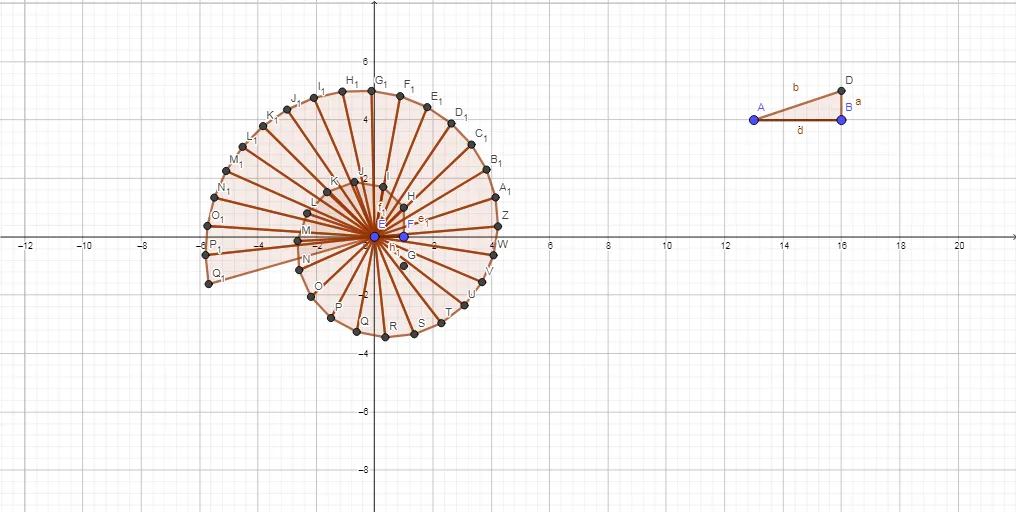
Demonstrates the geometric construction of the Square Root Spiral (also known as the Theodorus Spiral). This spiral consists of a sequence of right triangles where each hypotenuse represents consecutive square roots (√2, √3, √4...) with the two legs being 1 and the previous hypotenuse. Core mathematical concepts: square roots, Pythagorean theorem, properties of right triangles, geometric representation of sequences. Construction details (from summary): Segment command for triangle sides, OrthogonalLine for perpendicular legs, Circle and Intersect to locate new vertices, Polygon to create sequential triangles, and 'kp' command for recursive growth. The spiral grows by adding right triangles one by one. Suitable for middle to high school mathematics teaching, ideal for understanding square roots, verifying the Pythagorean theorem, and observing the relationship between sequences and geometry.
GeoGebra Commands & Parameters
Segment(A, B) → fOrthogonalLine(B, f) → gCircle(B, 1) → cIntersect(c, g) → C, DPolygon(A, B, D) → t1, d, a, bSegment(E, F) → hOrthogonalLine(F, h) → iCircle(F, 1) → eIntersect(e, i) → G, HPolygon(E, F, H) → t2, h_1, e_1, f_1kp(E, H) → t3, Ikp(E, I) → t4, Jkp(E, J) → t5, Kkp(E, K) → t6, Lkp(E, L) → t7, Mkp(E, M) → t8, Nkp(E, N) → t9, Okp(E, O) → t10, Pkp(E, P) → t11, Qkp(E, Q) → t12, Rkp(E, R) → t13, Skp(E, S) → t14, Tkp(E, T) → t15, Ukp(E, U) → t16, Vkp(E, V) → t17, Wkp(E, W) → t18, Zkp(E, Z) → t19, A_1kp(E, A_1) → t20, B_1kp(E, B_1) → t21, C_1kp(E, C_1) → t22, D_1kp(E, D_1) → t23, E_1kp(E, E_1) → t24, F_1kp(E, F_1) → t25, G_1kp(E, G_1) → t26, H_1kp(E, H_1) → t27, I_1kp(E, I_1) → t28, J_1kp(E, J_1) → t29, K_1kp(E, K_1) → t30, L_1kp(E, L_1) → t31, M_1kp(E, M_1) → t32, N_1kp(E, N_1) → t33, O_1kp(E, O_1) → t34, P_1kp(E, P_1) → t35, Q_1
AI Drawing Prompt Reference
Draw a spiral composed of a sequence of right-angled triangles where each hypotenuse represents consecutive square roots (√2, √3...), with one leg being 1 and the other leg being the previous hypotenuse. Start with the first triangle and sequentially draw subsequent triangles to form the spiral, which grows progressively. Each triangle is constructed by drawing line segments and perpendicular lines, and using circles and intersection points to locate new vertices.
The prompt above was compiled from the original drawing commands and is for reference only.