
Spiraling Polygons: A Dynamic Sequence of Rotated and Scaled Shapes
Loading the math board and drawing, please wait…
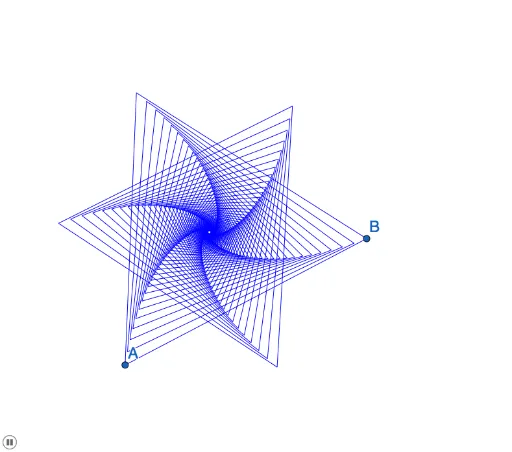
This GeoGebra example demonstrates a spiral-like pattern formed by a sequence of polygons that are successively rotated and scaled, visually connecting geometric transformations with numerical sequences. Core mathematical concepts include polygons, centroids, geometric mean, power functions, and similarity transformations of plane figures. The construction uses GeoGebra commands such as Polygon to create the initial polygon, Centroid to compute its center, and Sequence to generate subsequent polygons with proportional scaling and rotation. Key objects include n, B, A, poly1, f, g, h, i, j, k, l, C, D, E, F, H, G, w, u, and L_1. This resource is suitable for high school to early college students, ideal for exploring geometric transformations, sequence limits, and parametric dynamic graphics, and can also serve as an introduction to mathematical art and fractal-like patterns.
GeoGebra Commands & Parameters
Polygon(A, B, n) → poly1, f, E, F, H, g, h, i, j, k, l, C, DCentroid(poly1) → GSequence(Dilate[Rotate[poly1, (w * a), G], u^(a), G], a, 0, 100) → L_1
AI Drawing Prompt Reference
Create a spiral pattern formed by a sequence of regular polygons. Start with an initial polygon and locate its center. Then generate successive polygons by rotating each one around the center by a fixed angle and scaling it down by a constant factor. These polygons nest inside each other, creating a dynamic spiral-like arrangement that visually contracts and rotates inward. The drawing should show multiple clear polygon outlines, their shared center point, and a slider to control the number of iterations, illustrating the connection between geometric transformations and numerical sequences.
The prompt above was compiled from the original drawing commands and is for reference only.