
Visual Proof of the Sum of the First Odd Numbers
Loading the math board and drawing, please wait…
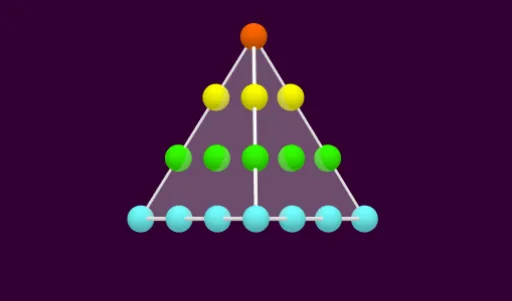
① This example demonstrates the classic identity that the sum of the first n odd numbers equals n², using a visual geometric construction that rearranges odd-numbered blocks into a square. ② The core mathematical concepts include arithmetic series, square numbers, and the geometric interpretation of algebraic identities, involving sequences, rational numbers, and series. ③ The construction uses GeoGebra commands such as Rotate, Mirror, Midpoint, Polygon, Tetrahedron, Point, Intersect, and Line to create symmetric shapes and precisely position vertices and edges, enabling a clear visual transformation. ④ It is suitable for middle and high school mathematics education, particularly for teaching summation formulas, exploring connections between geometry and algebra, and as an interactive demonstration or student exploration activity.
GeoGebra Commands & Parameters
Rotate(A, 120°) → A'Rotate(A, (-(120°))) → A'_1Polygon(A, A', A'_1) → t1, a'_1, a, a'Tetrahedron(t1, true) → b, B, face1, faceAA'B, face2, arêteAB, arête1, arêteA'BPoint(a'_1) → CIntersect(a'_1, yAxis) → DPoint(a'_1) → EPoint(a'_1) → FPoint(a'_1) → GLine(G, arêteAB) → fLine(F, arêteAB) → gLine(E, arêteAB) → hLine(D, arêteAB) → iLine(C, arêteAB) → jLine(C, arêteA'B) → kLine(D, arêteA'B) → lLine(E, arêteA'B) → mLine(F, arêteA'B) → nLine(G, arêteA'B) → pIntersect(k, arêteAB) → HIntersect(f, arêteA'B) → IIntersect(arêteAB, l) → JIntersect(f, k) → KIntersect(arêteA'B, g) → LIntersect(m, arêteAB) → MIntersect(f, l) → NIntersect(k, g) → OIntersect(arêteA'B, h) → PMirror(I, q) → I'Mirror(K, q) → K'Mirror(L, q) → L'Mirror(N, q) → N'Mirror(O, q) → O'Mirror(P, q) → P'Mirror(G, q) → G'Mirror(F, q) → F'Mirror(E, q) → E'Mirror(D, q) → D'Mirror(C, q) → C'Mirror(A', q) → A''Polygon(P', M, P) → t2, p_1, p', m_1Tetrahedron(t2, true) → c, Q, facePP'Q, faceMP'Q, faceMPQ, arêteP'Q, arêtePQ, arêteMQLine(K', K) → rRotate(l3, (s(d) * an), r) → l3'Rotate(l5, (s(d) * an), r) → l5'Rotate(l7, (s(d) * an), r) → l7'Rotate(c, (s(d) * an), r) → c'Rotate(B, (s(d) * an), r) → B'Midpoint(P, P') → RRotate(R, (s(d) * an), r) → R'Midpoint(M, B) → SRotate(S, (s(d) * an), r) → S'Line(R', S') → tRotate(l3', (s(d) * 45°), t) → l3''Rotate(l7', (s(d) * 45°), t) → l7''Rotate(l5', (s(d) * 45°), t) → l5''Rotate(B', (s(d) * 45°), t) → B''Rotate(c', (s(d) * 45°), t) → c''Rotate(Segment[Rotate[P, (s(d) * an), r], Rotate[P', (s(d) * an), r]], (s(d) * 45°), t) → e
AI Drawing Prompt Reference
Draw an equilateral triangle and rotate it 120 degrees twice to form a larger triangle with three vertices. Place several points along one side and draw parallel lines from these points to the opposite side, creating a grid-like division. Mirror the triangle across a symmetry axis to obtain a symmetric counterpart. Within the mirrored triangle, connect corresponding points with line segments to form smaller triangles and quadrilaterals. Finally, rotate part of the figure around a line by a certain angle to show how odd-numbered blocks rearrange into a square, illustrating that the sum of the first n odd numbers equals n squared.
The prompt above was compiled from the original drawing commands and is for reference only.