
n-gon with Inner Similar n-gon Construction
Loading the math board and drawing, please wait…
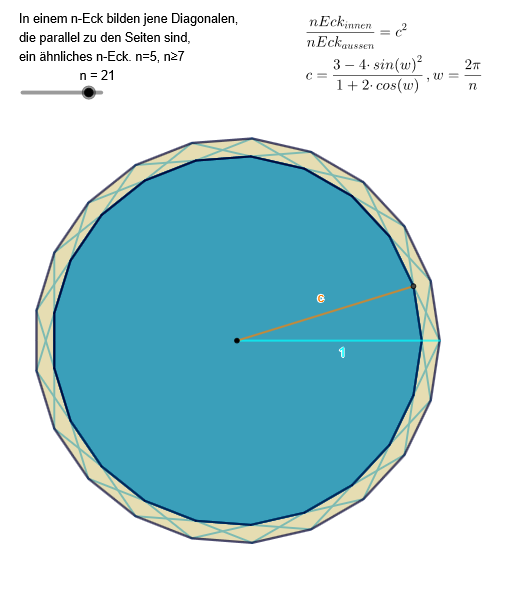
This GeoGebra example demonstrates how to construct a similar n-gon inscribed within an arbitrary n-gon. By adjusting the value of n using a slider, users can observe how the inner and outer polygons change together. Key mathematical concepts include similar transformations, polygon properties, and angle relationships. Construction highlights: The Sequence command generates vertex sequences for the n-gon, Polygon creates the polygons, Intersect finds key intersection points, and Segment connects vertices to form the inner polygon. Ideal for middle and high school students learning about polygons, similarity, and geometric construction, as well as for exploring general patterns of inscribed polygons.
GeoGebra Commands & Parameters
Sequence((cos(((2 * k) * π / n)), sin(((2 * k) * π / n))), k, 0, n + 2) → P, {(1, 0), (0.9555728057861407, 0.2947551744109042), (0.8262387743159949, 0.5633200580636221), (0.6234898018587336, 0.7818314824680298), (0.365341024366395, 0.9308737486442042), (0.07473009358642417, 0.9972037971811801), (-0.22252093395631434, 0.9749279121818236), (-0.5000000000000002, 0.8660254037844386), (-0.7330518718298263, 0.6801727377709194), (-0.900968867902419, 0.43388373911755823), (-0.9888308262251285, 0.14904226617617428), (-0.9888308262251285, -0.14904226617617447), (-0.9009688679024191, -0.433883739117558), (-0.7330518718298262, -0.6801727377709195), (-0.4999999999999996, -0.8660254037844388), (-0.2225209339563146, -0.9749279121818236), (0.07473009358642436, -0.9972037971811801), (0.3653410243663954, -0.9308737486442041), (0.6234898018587334, -0.7818314824680299), (0.8262387743159949, -0.563320058063622), (0.9555728057861408, -0.2947551744109039), (1, 0), (0.9555728057861407, 0.29475517441090426), (0.8262387743159947, 0.5633200580636223)}Polygon(Sequence[P(k), k, 1, n]) → VSequence(Segment[P(k), P(k + 3)], k, 1, n + 1) → S, {0.8677674782351162, 0.8677674782351162, 0.8677674782351164, 0.8677674782351162, 0.8677674782351164, 0.8677674782351161, 0.8677674782351162, 0.8677674782351161, 0.8677674782351161, 0.8677674782351162, 0.8677674782351161, 0.8677674782351166, 0.8677674782351162, 0.8677674782351162, 0.8677674782351161, 0.8677674782351161, 0.8677674782351162, 0.8677674782351161, 0.8677674782351164, 0.8677674782351161, 0.8677674782351161, NaN}Intersect(S(1), S(2)) → Q1Intersect(S(2), S(3)) → Q2Polygon(Q1, Q2, n) → V1, f, q, i_1, k_1, m_1, p_1, r_1, t_1, c_1, d_1, f_2, g, h_2, j_2, l_2, n_2, q_2, A, B, C, D, E, h, F, G, H, T, W, A_1, C_1, E_1, G_1, J_1, i, K_1, M_1, O_1, Q_1, S_1, U_1, W_1, j, k, l, m, pPolygon(Q1, Q2, n) → V1', r_2, g_3, h_3, i_3, j_3, k_3, l_3, m_3, n_3, p_3, q_3, s_2, r_3, s_3, t_3, a_3, b_3, Z_1, A_2, B_2, C_2, D_2, t_2, E_2, F_2, G_2, H_2, I_2, J_2, K_2, L_2, M_2, N_2, a_2, O_2, P_2, Q_2, R_2, S_2, T_2, U_2, b_2, c_2, d_2, e_2, f_3Segment(I, (1, 0)) → sSegment(I, J) → r
AI Drawing Prompt Reference
Draw an adjustable n-gon and construct a similar n-gon inscribed within it. Adjusting the value of n allows you to observe how the outer and inner polygons change together. Key objects include the outer polygon, internal line segments connecting vertices, and the inner polygon formed by intersection points. The construction order is to generate vertex sequences, draw the outer polygon, connect vertices to form internal segments, and finally use intersection points to draw the inner polygon.
The prompt above was compiled from the original drawing commands and is for reference only.