
Kürschák Hinged Puzzle Proof: Dodecagon and Square
Loading the math board and drawing, please wait…
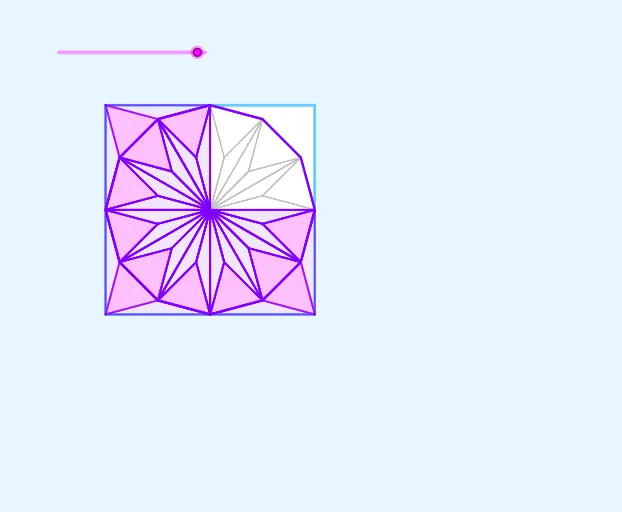
This example visualizes a Kürschák-style hinged-puzzle argument showing how a regular dodecagon’s decomposition and rotation relationships can be matched to the geometric structure of a square. It emphasizes invariant geometry: by rotating and reflecting hinged parts, lengths and angles are preserved, turning a seemingly complex assembly into a verifiable planar proof. Key concepts include polygon geometry, construction of equilateral and isosceles triangle configurations, and proof by geometric transformations (symmetry and congruence). Construction uses GeoGebra commands such as Point to define the skeleton of vertices, Rotate for repositioning hinged pieces, Polygon to build the dodecagon/square outlines (e.g., poly1 and poly2), Flatten to unfold/lay parts into one plane, OrthogonalLine for perpendicular constructions, Intersect to compute key junction points, and Mirror plus LineBisector to enforce symmetry and equal-distance conditions. Suitable for high-school geometry, interactive proof demonstrations, and transformation-based geometry practice.
GeoGebra Commands & Parameters
Point(xAxis) → ARotate(A, (360° * 1 / 12)) → A_1Polygon(A, A_1, 12) → poly1, f, p_{2}, q, r, B, C, D, E, F, G, H, g, I, J, K, h, i, j, k, l, m, nPolygon(A, A_1, 3) → poly2, s, t, a, LPolygon(O, A, L) → t1, l_1, o, a_1Polygon(O, A_1, L) → t2, l_2, o_1, bPolygon(A_1, B, 3) → poly3, c, d, e, MPolygon(B, C, 3) → poly4, f_1, g_1, h_1, NPolygon(O, A_1, M) → t3, m_1, o_2, i_1Polygon(O, M, B) → t4, b_1, o_3, m_2Polygon(O, N, B) → t5, b_2, o_4, n_1Polygon(O, N, C) → t6, c_1, o_5, n_2Flatten(Sequence[Rotate[l1, (k * 90°)], k, 1, 3]) → l2OrthogonalLine(A, xAxis) → j_1OrthogonalLine(C, yAxis) → k_1Intersect(j_1, k_1) → PMirror(P, xAxis) → P'Polygon(P', P, 4) → poly5, q_1, r_1, s_1, t_1, Q, RRotate(O, ((-p(u)) * 270°), A) → O'Rotate(A, ((-p(u)) * 270°), A) → A'Rotate(L, ((-p(u)) * 270°), A) → L'Polygon(O', A', L') → t1', l', o', a'Polygon(L', A, 3) → poly6, p_1, d_1, e_1, SMirror(A, a') → A'_{1}Rotate(S, (p(u) * 60°), O') → S'Rotate(L', (p(u) * 60°), O') → L''Polygon(O', L'', S') → t7, s', f_2, l''Mirror(L'', l'') → L'''Rotate(L''', (p(u) * (-360 + 180)°), S') → TRotate(O', (p(u) * (-(180°))), S') → O''Polygon(O'', S', T) → t8, t_2, o'', g_2Polygon(T, S', 3) → poly7, h_2, i_2, j_2, URotate(U, (p(u) * 150°), T) → U'Rotate(S', (p(u) * 150°), T) → S''Polygon(U', T, S'') → t9, s'', u', t_3Rotate(U, (p(u) * 60°), O'') → SSRotate(T, (p(u) * 60°), O'') → T'Polygon(O'', T', SS) → t10, u'_{1}, k_2, t'Rotate(O'', (p(u) * (-(180°))), SS) → O'''Rotate(poly6, ((p(u))^(2) * 150°), L') → poly6'LineBisector(O', O'') → q_2LineBisector(O'', O''') → r_2Mirror(poly6', q_2) → poly6''Mirror(O'', r_2) → O'''_{1}Mirror(S', r_2) → S''_{1}Mirror(T, r_2) → T'_{1}Polygon(O'''_{1}, S''_{1}, T'_{1}) → t8', t'_{1}, o'''_{1}, s''_{1}Mirror(O'', r_2) → O'''_{2}Mirror(T', r_2) → T''Mirror(SS, r_2) → SS'Polygon(O'''_{2}, T'', SS') → t10', ss', o'''_{2}, t''Mirror(poly6'', r_2) → poly6'''Rotate(l1, 0°) → l1'Flatten(Sequence[Rotate[{poly2, poly3, poly4}, (k * 90°)], k, 1, 3]) → ltMirror(poly3, g) → poly3'Flatten(Sequence[Rotate[{poly3'}, (k * 90°)], k, 1, 3]) → l3
AI Drawing Prompt Reference
Draw a geometric proof diagram showing a regular dodecagon and a square connected by rotations and reflections. The figure should include vertices of the dodecagon, equilateral and isosceles triangle configurations, and constructions linking them via symmetry and congruence. Describe the logical sequence: start with the dodecagon, rotate to form the square, then reflect and connect points to complete the proof.
The prompt above was compiled from the original drawing commands and is for reference only.