
Translating Rhombuses and Hexagons to Build a Snowflake
Loading the math board and drawing, please wait…
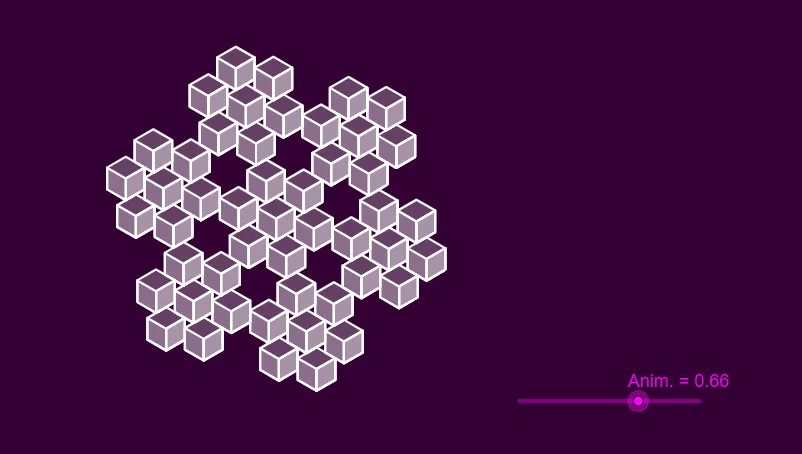
This example demonstrates how to construct a snowflake-like figure by translating (gliding) rhombus and hexagon shapes and arranging multiple congruent tiles into a symmetric pattern. The key mathematical ideas are geometric transformations—especially translation—together with vector-based displacement, polygon construction, and intersection-based layout to determine exact connecting boundaries. In GeoGebra, the construction uses Point and Polygon to create the base vertices and tile shapes, Intersect to compute where edges meet so the pieces fit correctly, Vector to represent translation directions and magnitudes, and Translate to generate repeated copies of the tiles. Finally, Flatten is used to simplify the layered structure into a clear final graphic. The approach is suitable for secondary-school geometry lessons and for learners exploring dynamic geometry, symmetry, and transformation-driven pattern design.
GeoGebra Commands & Parameters
Point(yAxis) → CPoint(yAxis) → FPolygon(A, B, C, D, E, F) → poly1, a, b, c, d, e, fIntersect(xAxis, yAxis) → GPolygon(A, G, C, B) → q1, a_1, g, c_1, b_1Polygon(D, C, G, E) → q2, i, j, k, lVector(C, F) → uVector(F, E) → vTranslate(l1, Vector[u + ((2 * p(h)) * v)]) → l2Translate(l1, Vector[u + (2 * v) - (p(h) * u)]) → l3Vector(A, D) → wVector(E, B) → mTranslate(l1, Vector[w + (p(h) * m)]) → l4Translate(l1, Vector[m + (p(h) * u)]) → l6Translate(l1, Vector[(-u) - (p(h) * w)]) → l5Translate(l1, Vector[(-w) - (p(h) * m)]) → l7Flatten({l1, l2, l3, l4, l5, l6, l7}) → L7Translate(L7, Vector[(3 * u) + ((3 * p(h)) * w)]) → L7'Translate(L7, Vector[(3 * w) + ((3 * p(h)) * m)]) → L7'_{1}Translate(L7, Vector[(3 * m) + ((3 * p(h)) * u)]) → L7'_{2}Translate(L7, Vector[(-3 * u) - ((3 * p(h)) * w)]) → L7'_{3}Translate(L7, Vector[(-3 * w) - ((3 * p(h)) * m)]) → L7'_{4}Translate(L7, Vector[(-3 * m) - ((3 * p(h)) * u)]) → L7'_{5}
AI Drawing Prompt Reference
Create a snowflake-like symmetric pattern by translating rhombus and hexagon tiles. Start with a central hexagon built from six vertices on the axes, then split it into two rhombi using the origin. Define three translation vectors to shift the base hexagon, producing seven interlocking copies that form a central cluster. Then translate this entire cluster three times along each of three directions, yielding six outer groups. Ensure all edges meet precisely, resulting in a six-fold symmetric snowflake composed of congruent tiles.
The prompt above was compiled from the original drawing commands and is for reference only.