
Spiral on a Sphere
Loading the math board and drawing, please wait…
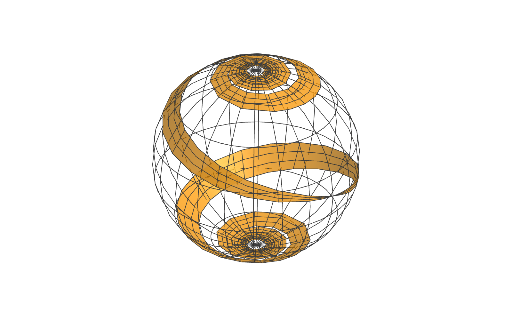
This example demonstrates a spiral on a sphere. It involves concepts of spherical geometry and parametric equations. Using the Surface and CurveCartesian commands, the spiral's trajectory can be constructed. Suitable for high school mathematics education, particularly in coordinate geometry and solid geometry.
GeoGebra Commands & Parameters
Surface((cos(u) * sin(v)), (sin(u) * sin(v)), cos(v), u, 0, (2 * π), v, 0, π) → cCurveCartesian(cos(t) / sqrt(1 + (0.4^(2) * t^(2))), sin(t) / sqrt(1 + (0.4^(2) * t^(2))), (-(((0.4 * t)) / sqrt(1 + (0.4^(2) * t^(2))))), t, (-2 * π), (2 * π)) → aCurveCartesian(cos(t) / sqrt(1 + (0.3^(2) * t^(2))), sin(t) / sqrt(1 + (0.3^(2) * t^(2))), (-(((0.3 * t)) / sqrt(1 + (0.3^(2) * t^(2))))), t, (-2 * π), (2 * π)) → bSurface(((1 - u) * b(t)) + (u * a(t)), u, -1, 1, t, (-10 * π), (10 * π)) → d
AI Drawing Prompt Reference
Draw a spiral on the surface of a sphere. First, create a unit sphere. Then, draw two spirals on the sphere, with their radii decreasing as the angle increases. Finally, use these two spirals to generate a spiral surface, showing the dynamic change of the spiral on the sphere.
The prompt above was compiled from the original drawing commands and is for reference only.