
Special Line through Triangle V1 (Dynamic Illustration & Theorem Discovery)
Loading the math board and drawing, please wait…
In collections
Congruence (CO) Cluster
Congruence (Vol 2)
CCSS High School: Geometry (Congruence) Volume 2
CCSS High School: Geometry (Congruence) Volume 2
CCSS High School: Geometry (Congruence) Volume 2
Geometry (Congruence) Volume 2
CCSS High School: Geometry (Congruence) Volume 2
CCSS High School: Geometry (Congruence) Volume 2
CCSS High School: Geometry (Congruence) Volume 2
CCSS High School: Geometry (Congruence) Volume 2
CCSS High School: Geometry (Congruence) Volume 2
CCSS High School: Geometry (Congruence) Volume 2
CCSS High School: Geometry (Congruence) Volume 2
Gail LeBlancCCSS High School: Geometry (Congruence) Volume 2
CCSS High School: Geometry (Congruence) Volume 2
Triangle Theorems
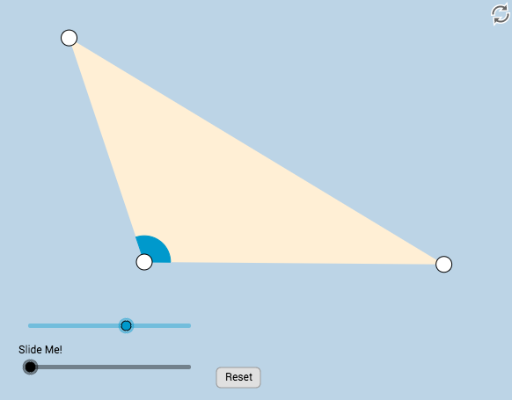
This example dynamically illustrates the property of a parallel line through the midpoint of one side of a triangle, facilitating informal theorem discovery. Key mathematical concepts include parallel lines, midsegment theorem, and dynamic geometry exploration. It utilizes commands like Ray, Segment, Rotate, Angle, Point, Midpoint, Circle, Intersect, Line, Polygon, Vector, and Translate. Suitable for high school mathematics education, encouraging intuitive understanding and proof exploration of geometric theorems.
GeoGebra Commands & Parameters
Ray(A, B) → fSegment(A, B) → gRotate(B, α, A) → B'Angle(B, A, B') → βRay(A, B') → hPoint(h) → CSegment(C, B) → iSegment(A, C) → jMidpoint(j) → DMidpoint(i) → ESegment(D, E) → kMidpoint(k) → FMin({j / 2, k / 2}) → aCircle(A, (0.35 * a)) → cIntersect(c, j, 1) → GIntersect(c, g, 1) → HCircleSector(A, H, G) → dLine(D, E) → lCircle(D, 2) → eCircle(E, 2) → pIntersect(e, l, 1) → IIntersect(p, l, 2) → JRay(D, I) → mRay(E, J) → nPolygon(A, B, C) → poly1, c_1, a_1, bDilate(A, If[0 < o ≤ 1, 1 - o, 0], B) → A'Segment(A, A') → qDilate(A, If[1 < o ≤ 2, 2 - o, 0], D) → A'_1Segment(A, A'_1) → rDilate(D, If[2 < o ≤ 3, 3 - o, 0], C) → D'Segment(D, D') → sRotate(A, If[3 < o ≤ 4, ((o - 3) * π), π], D) → A'_2Rotate(A'_1, If[3 < o ≤ 4, ((o - 3) * π), π], D) → KSegment(A'_2, K) → r'Dilate(B, If[4 < o ≤ 5, 5 - o, 0], E) → B'_1Segment(B, B'_1) → tDilate(E, If[5 < o ≤ 6, 6 - o, 0], C) → E'Segment(E, E') → f_1Rotate(B, If[6 < o ≤ 7, ((-(o - 6)) * π), (-π)], E) → B'_2Rotate(B'_1, If[6 < o ≤ 7, ((-(o - 6)) * π), (-π)], E) → LSegment(B'_2, L) → t'Dilate(D, If[7 < o ≤ 8, 8 - o, 0], F) → D'_1Segment(D, D'_1) → g_1Dilate(A, If[8 < o ≤ 9, 9 - o, 0], D) → A'_3Vector(A, A'_3) → uTranslate(d, u) → d'Dilate(F, If[9 < o ≤ 10, 10 - o, 0], E) → F'Segment(F, F') → h_1