
SolveMyMaths Action 1! Dynamic Area & Vector Geometry
Loading the math board and drawing, please wait…
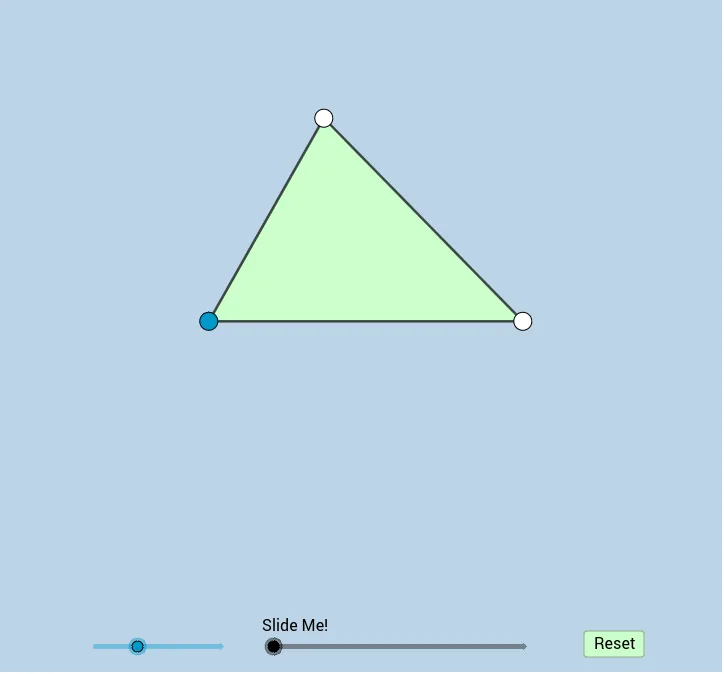
① This example is a dynamic and modifiable geometric illustration of a problem posed by Ed Southall on Twitter, allowing users to explore changing configurations via sliders and draggable points. ② Core mathematical concepts include fractions, logical reasoning, addition, area computation, and vector operations, involving polygons, circles, sectors, and rotations. ③ Construction highlights: using GeoGebra commands such as Segment, Rotate, Angle, Ray, Point, Polygon, Circle, Intersect, CircleSector, Dilate, Vector, Translate, Min, Line, and Midpoint, the applet builds multiple points, segments, circles, sectors, and vectors, with dynamic parameters controlling the state. ④ Suitable for middle school and above, this is ideal for teachers and students to investigate area relationships, vector decomposition, and dynamic mathematical modeling, and can serve as a resource for math competitions or classroom discussions.
GeoGebra Commands & Parameters
Segment(A, B) → fRotate(B, (a * π / 180), A) → B'Angle(B, A, B') → αRay(A, B') → gPoint(g) → CSegment(A, C) → hSegment(C, B) → iPolygon(A, B, C) → t1, c, a_1, bCircle(A, (0.15 * Min[h, f])) → dIntersect(d, f) → D,Intersect(d, h) → E,CircleSector(A, D, E) → eRotate(B, π / 3, C) → B'_1Rotate(C, π / 3, A) → C'Rotate(B, π / 3, A) → B'_2Rotate(A, If[0 < j ≤ 1, (j * π / 3), π / 3], A) → A'Rotate(C, If[0 < j ≤ 1, (j * π / 3), π / 3], A) → C'_1Segment(A', C'_1) → h'Rotate(C, If[0 < j ≤ 1, (j * π / 3), π / 3], C) → C'_2Rotate(B, If[0 < j ≤ 1, (j * π / 3), π / 3], C) → B'_3Segment(C'_2, B'_3) → i'Rotate(A, If[1 < j ≤ 2, ((-(j - 1)) * π / 3), ((-π)) / 3], C) → A'_1Rotate(C, If[1 < j ≤ 2, ((-(j - 1)) * π / 3), ((-π)) / 3], C) → C'_3Segment(A'_1, C'_3) → h'_1Rotate(C, If[1 < j ≤ 2, ((-(j - 1)) * π / 3), ((-π)) / 3], B) → C'_4Rotate(B, If[1 < j ≤ 2, ((-(j - 1)) * π / 3), ((-π)) / 3], B) → B'_4Segment(C'_4, B'_4) → i'_1Polygon(A, C, C'_1) → t2, c'_1, a_2, c_1Polygon(B, B'_3, C) → t3, c_2, b_1, b'_3Rotate(A, If[2 < j ≤ 3, ((j - 2) * π / 3), π / 3], A) → A'_2Rotate(B, If[2 < j ≤ 3, ((-(j - 2)) * π / 3), ((-π)) / 3], A) → B'_5Segment(A'_2, B'_5) → f'Rotate(A, If[3 < j ≤ 4, ((j - 3) * π / 3), π / 3], B) → A'_3Rotate(B, If[3 < j ≤ 4, ((-(j - 3)) * π / 3), ((-π)) / 3], B) → B'_6Segment(A'_3, B'_6) → f'_1Dilate(C'_1, If[5 < j ≤ 6, 6 - j, 0], B'_5) → FVector(C'_1, F) → uTranslate(A'_1, u) → GTranslate(C'_3, u) → HDilate(C, If[6 < j ≤ 7, 7 - j, 0], C'_1) → C'_5Vector(C, C'_5) → vTranslate(C'_2, v) → ITranslate(B'_3, v) → JPolygon(A, B'_5, B) → t4, b_2, a_3, b'_2Segment(A, B'_3) → lSegment(B, C'_1) → mMin(f, i) → nMin({f, i, h}) → oCircle(B, (0.2 * o)) → pIntersect(p, f, 1) → KIntersect(p, f'_1) → L,Intersect(p, m, 1) → MCircle(A, (0.2 * o)) → qLine(A, B'_3) → rIntersect(q, r, 1) → NRay(A, N) → sIntersect(q, f') → O,Angle(O, A, B'_3) → βAngle(C'_1, B, L) → γDilate(B'_3, If[4 < j ≤ 5, 5 - j, 0], A) → A'_4Dilate(C'_1, If[5 < j ≤ 6, 6 - j, 0], B) → B'_7Rotate(L, If[6 < j ≤ 7, ((-(j - 6)) * γ), (-γ)], B) → L'CircleSector(B, L', L) → d_1Rotate(O, If[7 < j ≤ 8, ((j - 7) * β), β], A) → O'CircleSector(A, O, O') → e_1Midpoint(A, B) → PLine(P, s) → f_1Line(B, s) → g_1Point(g_1) → QAngle(C'_1, B, Q) → δDilate(B, If[8 < j ≤ 9, 9 - j, 0], P) → B'_8Vector(B, B'_8) → wTranslate(d_1, w) → h_1Rotate(h_1, If[9 < j ≤ 10, ((j - 9) * π / 3), π / 3], P) → k_1Dilate(P, If[10 < j ≤ 11, 11 - j, 0], A) → P'Vector(P, P') → u_1Translate(k_1, u_1) → p_1Segment(A, B) → i_1Segment(B'_3, A'_4) → j_1Segment(C'_1, B'_7) → t