
Hexagon and Triangle Sequences: A Dynamic Growing Pattern
Loading the math board and drawing, please wait…
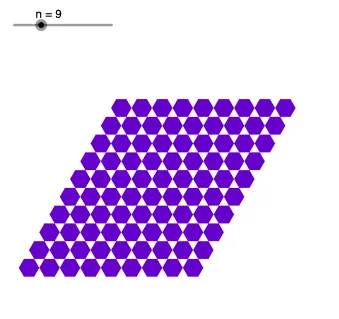
This GeoGebra example demonstrates a dynamic growing pattern composed of hexagons and triangles, where a sequence of polygons expands outward in a visually engaging manner. The core mathematical concepts involve sequences, vectors, polygon construction, and quadratic relationships, blending algebra with geometry. The construction uses the Polygon command to create base hexagons and triangles, the Vector command to define translation directions, and the Sequence command to generate a series of repeated geometric objects. A slider (n) controls the number of iterations, allowing users to observe how the pattern evolves. This resource is ideal for middle and high school students learning about sequences, geometric construction, and pattern recognition, and can also serve as a springboard for exploring quadratic functions and algebraic modeling in a visual context.
GeoGebra Commands & Parameters
Polygon(A, B, 6) → poly1, f, F, g, h, i, j, k, C, D, EVector(F, C) → uSequence(Translate[poly1, Vector[(k * u)]], k, 1, n) → l1Vector(A, D) → vSequence(Translate[l1, Vector[(k * v)]], k, 1, n) → l2
AI Drawing Prompt Reference
Draw a dynamic growing pattern composed of hexagons and triangles, where the sequence of polygons expands outward to create a visually engaging design. Use a slider to control the number of iterations and observe how the pattern evolves. Start by constructing a base hexagon, then define a vector for translation direction, and use the sequence command to generate a series of repeated geometric objects. Combine translations of hexagons and triangles to form the expanding pattern.
The prompt above was compiled from the original drawing commands and is for reference only.