
Visual Pattern 86: A Dynamically Growing Square Sequence
Loading the math board and drawing, please wait…
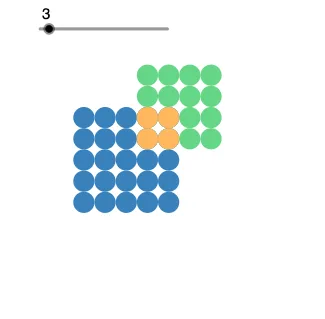
① This example demonstrates a visually engaging pattern where squares expand outward in a dynamic sequence, accompanied by circles, vectors, and auxiliary lines that evolve step by step, creating a rhythmic geometric growth. ② Core mathematical concepts include quadratic functions (area or side length varying with step index), sequences and series (terms increasing by a pattern), properties of squares and polygons, and the interplay between function graphs and geometric diagrams; also involving circles, vectors, and coordinate operations. ③ Construction highlights: using GeoGebra commands such as Circle to draw circles, Point to define key points, Vector to create direction vectors, and Sequence to generate series of objects (e.g., lists l1 through l6) parameterized by i and n, with sliders or parameters enabling dynamic updates, resulting in an interactive visual sequence. ④ Suitable for upper secondary to early university students, this example is ideal for exploring the connection between algebra and geometry, visualizing sequence patterns, and serving as a resource for mathematical modeling or art-integrated math lessons.
GeoGebra Commands & Parameters
Circle(A, B) → cPoint(c) → CVector(C, B) → vPoint(c) → DPoint(c) → EVector(D, E) → wSequence(Translate[c, Vector[((k - 5) * v)]], k, 1, n + 3) → l3Sequence(Translate[c, Vector[((k - 2) * v)]], k, 1, n + 2) → l1Sequence(Translate[l1, Vector[((2 - k) * w)]], k, 1, n + 2) → l2Sequence(Translate[l3, Vector[((-k) * w)]], k, 1, n + 3) → l4Sequence(Translate[c, Vector[((k - 2) * v)]], k, 1, n) → l5Sequence(Translate[l5, Vector[((-k) * w)]], k, 1, n) → l6
AI Drawing Prompt Reference
On a coordinate plane, start with two given points and draw a circle using one point and the other as a point on the circle. Choose key points related to those locations on the circle, then form two direction vectors from the key points to the base points. Using the circle center as a reference, repeatedly translate a set of points along the first vector with a step parameter to create an outward-growing square/ polygon sequence. Continue translating selected translated sets along the second vector for further growth across more steps. The final figure should show rhythmic expansion with auxiliary points and vectors guiding the evolving translations.
The prompt above was compiled from the original drawing commands and is for reference only.