
Parameter-driven polygon construction with vector sequence effects
Loading the math board and drawing, please wait…
In collections
Flowers and Polygons -IT
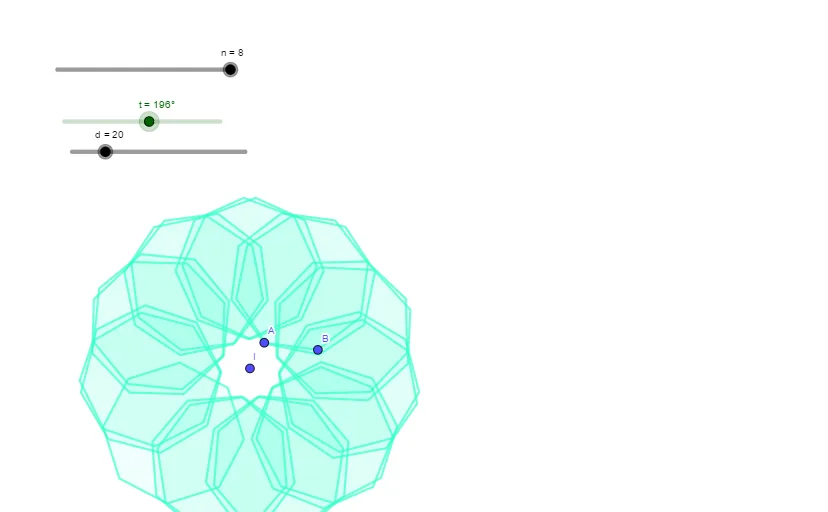
This GeoGebra example demonstrates how to generate a polygon by iterating a sequence of points, while combining lines, vectors, and function-driven (notably exponential) geometric rules to create a structured planar figure. The key mathematics includes polygon construction, the idea of a sequence (sequence) producing successive vertices, vector relationships that guide positioning, and functions that control lengths or connectivity patterns. Construction highlights from the provided build summary: it uses the GeoGebra commands Polygon and Sequence to create the main polygon poly1, with essential objects such as n, A, and B to parameterize the generated vertices; it then defines additional points (e.g., C, D, E, F, G, H, plus parameters like t, d, I) to extend the sequence-defined structure. Along the way, multiple dependent geometric/function objects (f, g, h, i, j, k, l, m, d and the transformed/related polygon poly1') are used to reflect the combined influence of exponential-type functions and vector/line constraints. Suitable for upper-secondary and early undergraduate students for learning parametric construction, sequence-based geometry, and connections between algebraic functions and geometric visualization.
GeoGebra Commands & Parameters
Polygon(A, B, n) → poly1, f, D, E, F, G, H, g, h, i, j, k, l, m, CSequence(Rotate[poly1, (t * k), I], k, 0, d) → poly1'
AI Drawing Prompt Reference
Create a parameter-driven polygon by iterating a sequence of points, combining vector relationships and function-driven (exponential) rules to form a structured planar figure. Use polygon and sequence commands to construct the main shape, extending its structure with additional points and parameters, showcasing how vectors and functions influence positioning and connectivity patterns to generate a complex geometric figure.
The prompt above was compiled from the original drawing commands and is for reference only.