
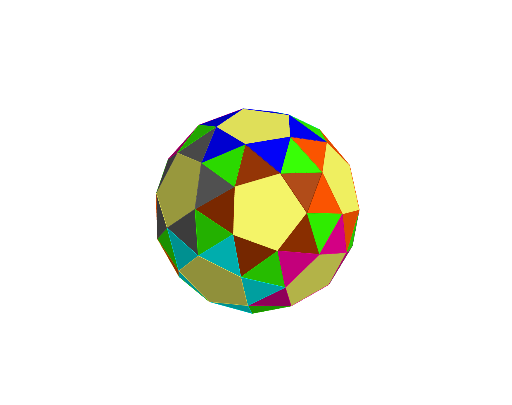
Snub Dodecahedron
Loading the math board and drawing, please wait…
In collections
Archimedean Solids
This example demonstrates the construction and properties of the Snub Dodecahedron, a complex three-dimensional solid. Key math concepts include solid geometry, polygon construction, rotation, centroid calculation, orthogonal lines and planes. The construction utilizes GeoGebra commands like Polygon, Rotate, Centroid, OrthogonalLine, Line, Sequence, Intersect, Midpoint, Plane, and OrthogonalPlane. Suitable for high school students and math enthusiasts studying 3D geometry construction and related topics.
GeoGebra Commands & Parameters
Polygon(A, B, 5, xOyPlane) → poly1, f, g, h, i, j, C, D, EPolygon(A, B, 3, xOyPlane) → poly2, k, l, m, FRotate(poly2, 152.93°, k) → poly2'Rotate(F, 152.93°, k) → F'Centroid(poly1) → GOrthogonalLine(G, poly1) → nRotate(poly2', 72°, n) → poly2''Rotate(poly2', 144°, n) → poly2''_{1}Rotate(poly2', -72°, n) → poly2''_{2}Rotate(poly2', -144°, n) → poly2''_{3}Line(B, F') → pRotate(poly2', -164.18°, p) → t2Rotate(A, -164.18°, p) → A'Rotate(A', 72°, n) → A''Rotate(F', 72°, n) → F''Polygon(F'', B, A') → t3_{1}, a', f'', bSequence(Rotate[t3_{1}, (72° * i), n], i, 1, 4) → l1, {1.9096081418592432, 1.9096081418592432, 1.9096081418592432, 1.9096081418592432}Centroid(poly2') → HOrthogonalLine(H, poly2') → qIntersect(n, q) → IMidpoint(F', B) → JMidpoint(F', A) → KLine(A'', F'') → rRotate(C, -152.93°, r) → C'Plane(C', F'', A'') → p_1OrthogonalLine(A'', p_1) → sRotate(F'', -108°, s) → F'''Midpoint(A'', F'') → MOrthogonalLine(F''', p_1) → tRotate(A'', -108°, t) → A'''OrthogonalLine(A''', p_1) → aRotate(F''', -108°, a) → LPolygon(A''', F''', A'', F'', L) → p1, a''', f''', a'', c, l_1Sequence(Rotate[p1, (i * 72°), n], i, 1, 4) → l3, {7.587305336597347, 7.587305336597347, 7.587305336597347, 7.587305336597347}Rotate(L, 72°, n) → L'Rotate(L, 72°, n) → L'_{1}Rotate(L, 144°, n) → L'_{2}Rotate(L, -72°, n) → L'_{3}Rotate(L, -144°, n) → L'_{4}Polygon(L, F'', A') → t3, d, l_2, ePolygon(L'_{1}, A'', F''') → t4, f_1, l'_{1}, g_1Centroid(p1) → NOrthogonalLine(N, p1) → h_1Rotate(t4, -72°, h_1) → t5Rotate(L'_{1}, -72°, h_1) → ORotate(O, -72°, h_1) → O'Rotate(O, 72°, n) → O'_{1}Rotate(O, 144°, n) → O'_{2}Rotate(O, -72°, n) → O'_{3}Rotate(O, -144°, n) → O'_{4}Rotate(O', 72°, n) → O''Rotate(O', 144°, n) → O''_{1}Rotate(O', -72°, n) → O''_{2}Rotate(O', -144°, n) → O''_{3}Rotate(A''', 72°, n) → PRotate(A''', 144°, n) → QRotate(A''', -72°, n) → RRotate(A''', -144°, n) → SRotate(F''', -72°, n) → TPolygon(O'', F''', L'_{1}) → t7, i_1, o'', j_1Sequence(Rotate[t7, (27° * i)]) → l8Rotate(t7, 72°, n) → t7'Rotate(t7', 72°, n) → t7''Rotate(t7'', 72°, n) → t7'''Rotate(t7''', 72°, n) → t1Polygon(O'', F''', O) → t8, o, k_1, m_1Rotate(t8, 72°, n) → t8'Rotate(t8', 72°, n) → t8''Rotate(t8'', 72°, n) → t8'''Rotate(t8''', 72°, n) → t9Rotate(t8, -72°, h_1) → t8'_{1}Rotate(t1, 72°, h_1) → t1'Line(O'', O) → n_1Rotate(F''', -152.93°, n_1) → UPlane(U, O'', O) → q_1OrthogonalLine(O'', q_1) → r_1Rotate(O, 108°, r_1) → O'_{5}OrthogonalLine(O'_{5}, q_1) → s_1Rotate(O'', 108°, s_1) → O'''OrthogonalLine(O''', q_1) → t_1Rotate(O'_{5}, 108°, t_1) → VPolygon(O''', V, O, O'', O'_{5}) → poly3, o''', v, o_1, a_1, o'_{5}Rotate(poly3, 72°, n) → poly3'Rotate(poly3', 72°, n) → poly3''Rotate(poly3'', 72°, n) → poly3'''Rotate(poly3''', 72°, n) → poly4Rotate(V, 72°, n) → V'Rotate(V, 144°, n) → V'_{1}Rotate(V'_{1}, 72°, n) → WRotate(W, 72°, n) → W'Rotate(O''', 72°, n) → ZRotate(Z, 72°, n) → Z'Rotate(Z', 72°, n) → Z''Rotate(Z'', 72°, n) → Z'''Rotate(O'_{5}, 72°, n) → A_1Rotate(A_1, 72°, n) → B_1Rotate(B_1, 72°, n) → C_1Polygon(B_1, O''_{3}, S) → t10, s_2, b_1, o''_{3}Rotate(t10, 72°, n) → t10'Rotate(t10, 144°, n) → t10'_{1}Rotate(t10, -72°, n) → t10'_{2}Rotate(t10, -144°, n) → t10'_{3}Rotate(t1', 72°, n) → t1''Rotate(t1'', 72°, n) → t1'''Rotate(t1''', 72°, n) → t11Rotate(t11, 72°, n) → t11'Polygon(W, B_1, O'_{4}) → t12, o'_{4}, w, c_1Rotate(t12, 72°, n) → t12'Rotate(t12', 72°, n) → t12''Rotate(t12'', 72°, n) → t12'''Rotate(t12''', 72°, n) → t13Polygon(O''', O'_{5}, V') → t14, v', d_1, e_1Rotate(t14, 72°, n) → t14'Rotate(t14', 72°, n) → t14''Rotate(t14'', 72°, n) → t14'''Rotate(t14''', 72°, n) → t15OrthogonalPlane(I, n) → p_2Rotate(t14'', 72°, h_1) → t14'''_{1}Rotate(W, 72°, h_1) → W'_{1}Rotate(t14'''_{1}, 72°, n) → t16Rotate(t14'''_{1}, 144°, n) → t17Rotate(t14'''_{1}, -72°, n) → t18Rotate(t14'''_{1}, -144°, n) → t19Rotate(W'_{1}, 72°, n) → D_1Rotate(D_1, 72°, n) → E_1Rotate(E_1, 72°, n) → F_1Rotate(F_1, 72°, n) → G_1Polygon(F_1, G_1, W'_{1}, D_1, E_1) → poly5, f_2, g_2, w'_{1}, h_2, i_2Polygon(G_1, O''', V') → t20, j_2, k_2, m_2Rotate(t20, 72°, n) → t20'Rotate(t20, -72°, n) → t20'_{1}Rotate(t20'_{1}, -72°, n) → t21Polygon(F_1, O''', G_1) → t22, n_2, q_2, r_2Rotate(t22, 72°, n) → t22'Rotate(t22', 72°, n) → t22''Rotate(t22'', 72°, n) → t22'''Rotate(t22''', 72°, n) → t23Polygon(D_1, Z', W) → t24, w_1, t_2, z'Polygon(F', B, A') → t25, a_2, f', b_2Rotate(t25, -72°, n) → t25'Rotate(t25, -144°, n) → t25'_{1}Rotate(t7, -72°, n) → t7'_{1}Rotate(t25'_{1}, -72°, n) → t26Rotate(t26, -72°, n) → t26'Polygon(T, A', L) → t27, l_3, t_3, c_2Polygon(O', L, A''') → t6, e_2, o', l_5Rotate(t6, 72°, n) → t6'Rotate(t6, -72°, n) → t6'_{1}Rotate(t6'_{1}, -72°, n) → t29Rotate(t29, -72°, n) → t29'Polygon(T, A', L) → t28, l_4, t_4, d_2Rotate(t28, -72°, n) → t28'_{3}Rotate(t28'_{3}, -72°, n) → t30Rotate(t30, -72°, n) → t30'Rotate(t3, -72°, n) → t3'Rotate(t3', -72°, n) → t3''Rotate(t3'', -72°, n) → t3'''Rotate(t3''', -72°, n) → t31Polygon(O'_{3}, R, T) → t32, t_5, o'_{3}, r_3Rotate(t32, 72°, n) → t32'Rotate(t32, 144°, n) → t32'_{1}Rotate(t32, -72°, n) → t32'_{2}Rotate(t32'_{2}, -72°, n) → t33
AI Drawing Prompt Reference
Construct the geometric wireframe of a Snub Dodecahedron in 3D space. Start by choosing a base plane and drawing a pentagon on it, forming one set of vertices. On the same plane, draw an initial triangle that will serve as the face seed for another part of the solid. Compute the centroid of the pentagon and use the perpendicular line through it as one rotation axis, then rotate the triangle repeatedly around this axis by multiples of 72° to generate the surrounding triangular faces. Build additional 3D structure by drawing lines through key corresponding vertices, finding their intersections, and locating further planes through key points tied to the constructed faces. Use orthogonality (perpendiculars from face centers to planes/lines) to define auxiliary directions, then continue rotating specific edges/triangles to complete the symmetric net of the Snub Dodecahedron.
The prompt above was compiled from the original drawing commands and is for reference only.