
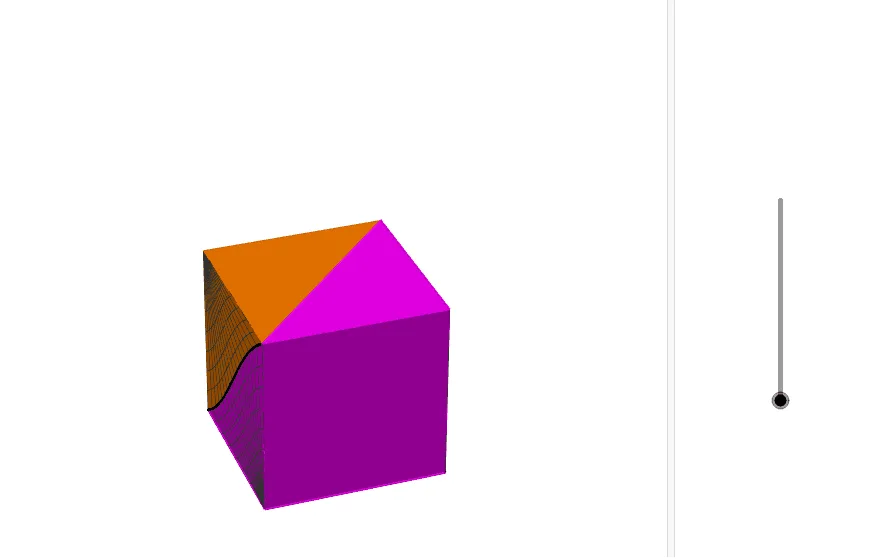
Screwed Bisection of a Cube
Loading the math board and drawing, please wait…
This example demonstrates the geometric phenomenon of bisecting a cube along a median line using a screw-like rotation. It involves core mathematical concepts such as solid geometry, rotational transformations, median lines, quadratic functions, and hypergeometric distributions. The construction utilizes GeoGebra commands/objects like Point, Cube, CurveCartesian, Rotate, Surface, Translate, and Polygon. Suitable for high school and above students studying spatial geometry, transformations, and probability statistics, or for mathematical teaching demonstrations.
GeoGebra Commands & Parameters
Point(Circle[B, Distance[A, B], Segment[A, B]]) → CCube(A, B, C) → a, D, faceCDHG, faceEFGH, edgeAD, edgeAB, edgeBC, edgeCD, edgeAE, edgeDH, edgeEH, edgeEF, E, edgeBF, edgeFG, edgeCG, edgeGH, F, G, H, faceABCD, faceADHE, faceABFE, faceBCGFCurveCartesian(1, tan(t - π / 4), (4 * t / π), t, 0, π / 2) → eRotate(e, π) → fSurface((u * cos(t - π / 4)), (u * sin(t - π / 4)), (4 * t / π), t, 0, π / 2, u, -2, 2) → bSurface((u * x(e(t))) + ((1 - u) * x(f(t))), (u * y(e(t))) + ((1 - u) * y(f(t))), (u * z(e(t))) + ((1 - u) * z(f(t))), t, 0, π / 2, u, 0, 1) → dTranslate(Rotate[d, n, zAxis], Vector[(0, 0, (4 * n / π))]) → gTranslate(Rotate[Polygon[E, F, G], n, zAxis], Vector[(0, 0, (4 * n / π))]) → t1Translate(Rotate[Polygon[D, A, B], n, zAxis], Vector[(0, 0, (4 * n / π))]) → t2Translate(Rotate[Polygon[A, B, F, E], n, zAxis], Vector[(0, 0, (4 * n / π))]) → q1Translate(Rotate[Surface[1, (-u) + ((1 - u) * y(e(t))), (2 * u) + ((1 - u) * z(e(t))), t, 0, π / 2, u, 0, 1], n, zAxis], Vector[(0, 0, (4 * n / π))]) → hSurface(-1, (-u) + ((1 - u) * y(f(t))), ((1 - u) * z(f(t))), t, 0, π / 2, u, 0, 1) → iTranslate(Rotate[i, n, zAxis], Vector[(0, 0, (4 * n / π))]) → jSurface(1, (u * y(e(t))) + (1 - u), (u * z(e(t))), t, 0, π / 2, u, 0, 1) → kSurface(-1, (u * y(f(t))) + (1 - u), (u * z(f(t))) + ((1 - u) * 2), t, 0, π / 2, u, 0, 1) → lPolygon(E, H, G) → t3, g_1, e_1, h_1Polygon(B, C, D) → t4, d_1, b_1, c_1Polygon(C, D, H, G) → q2, c_2, d_2, h_2, g_2