
Sample Size for Population Proportion
Loading the math board and drawing, please wait…
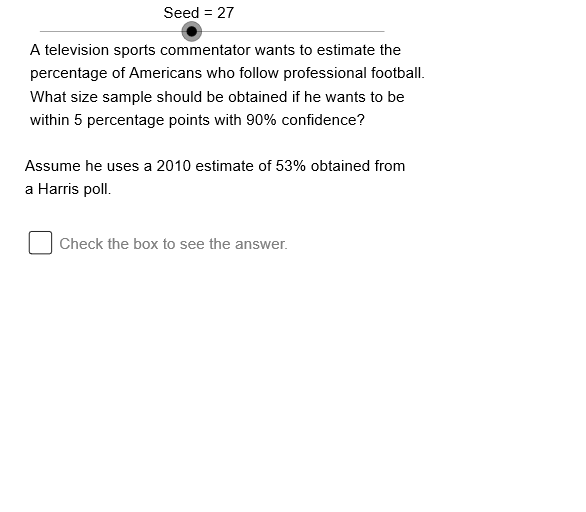
This example demonstrates how to calculate the sample size needed to estimate population proportions within a given margin of error. Key math concepts include sample size calculation, margin of error, and probability & statistics. It utilizes GeoGebra commands like Sequence, Element, Mod, If, and objects such as ErrSq, Seed, OpSq. Suitable for high school and above students in probability statistics education and practice.
GeoGebra Commands & Parameters
Sequence(Mod[5 + (29 * k), 61] + 1, k, 1, 60) → OpSq, {35, 3, 32, 61, 29, 58, 26, 55, 23, 52, 20, 49, 17, 46, 14, 43, 11, 40, 8, 37, 5, 34, 2, 31, 60, 28, 57, 25, 54, 22, 51, 19, 48, 16, 45, 13, 42, 10, 39, 7, 36, 4, 33, 1, 30, 59, 27, 56, 24, 53, 21, 50, 18, 47, 15, 44, 12, 41, 9, 38}Element(OpSq, Seed) → Op1Mod(Op2, 2) → PorPIf(PorP ≟ 0, "percentage", "proportion") → PorPTxElement(ErrSq, Mod[Op2, 5] + 1) → ErrElement(CnfSq, Mod[Op3, 4] + 1) → CnfElement(MltSq, Mod[Op1, 6] + 1) → MltElement(EstSq, Mod[Op2, 6] + 1) → EstIf(ErrPrc ≟ 1, " book", " books") → BkSPIf(ErrPrc ≟ 1, " point", " points") → PTMod(Op1, 2) → PEIf(PE ≟ 1, SzPE, SzNE) → SizeIf(PorP ≟ 0, EstPrc, Est) → PorPNmIf(PorP ≟ 0, "%", "") → PrSgElement(PSSq, ChNm2) → PS0