
Rotations and Reflections on the Cartesian Plane
Loading the math board and drawing, please wait…
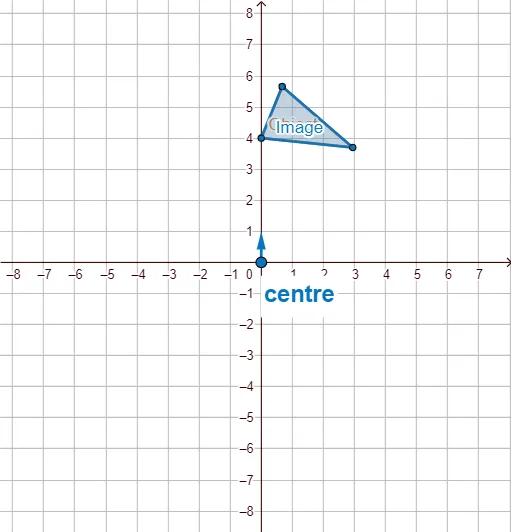
This example demonstrates how a polygon on the Cartesian plane transforms under rotations, translations, and reflections, highlighting the correspondence of vertices and the role of key angles. The main mathematical ideas are geometric transformations (Rotate, Translate, Mirror, Dilate), analytic/coordinate geometry construction, and angle measurement using Angle together with geometric primitives like lines, rays, and vectors (Line, Ray, Vector). In the construction, Polygon is used to create the initial polygon (poly1) and its transformed copies (poly1′, poly1″, …). Rotate generates rotated images of points such as A, B, C, D and their counterparts B′, C′, D′ and so on. Translate provides shifted vertex sets, while Mirror produces symmetric images across a line. Line, Ray, and Vector define directions and reference geometry needed for each transformation, and Angle labels the driving rotation angle α and related angle relationships. Dilate can be used to introduce scaling when forming additional geometric stages. Suitable for middle school through early university geometry lessons, as well as for learning visual proof techniques about congruence and transformation-based correspondences.
GeoGebra Commands & Parameters
Polygon(C, D, B) → poly1, b, c, dDilate(C, a, A) → C'_1Dilate(D, a, A) → D'_1Dilate(B, a, A) → B'_1Polygon(C'_1, D'_1, B'_1) → poly1'_1, b', c', d'Ray(A, C) → eRay(A, B) → fRay(A, D) → gTranslate(C, Vector[(horz, vert)]) → C'_2Translate(D, Vector[(horz, vert)]) → D'_2Translate(B, Vector[(horz, vert)]) → B'_2Polygon(C'_2, D'_2, B'_2) → poly1'_2, b'_1, c'_1, d'_1Vector(C, C'_2) → uVector(B, B'_2) → vVector(D, D'_2) → wRotate(C, (-α), A) → C'_3Rotate(D, (-α), A) → D'_3Rotate(B, (-α), A) → B'_3Polygon(C'_3, D'_3, B'_3) → poly1'_3, b'_2, c'_2, d'_2Line(F, E) → hMirror(C, h) → C'Mirror(D, h) → D'Mirror(B, h) → B'Polygon(C', D', B') → poly1', b'_3, c'_3, d'_3Vector(A, G) → zAngle(G, A, H) → βPolygon(I, J, K, L) → poly2, i, j, k_1, lPoint(j) → PPolygon(M, N, O, P) → poly3, m, n, o, p
AI Drawing Prompt Reference
Draw an initial triangle ABC, then rotate it around point A to generate the rotated triangle A'B'C'. Next, translate triangle A'B'C' along a vector to create the translated triangle A''B''C''. Finally, mirror triangle A''B''C'' across a line h to generate the mirrored triangle A'''B'''C'''.
The prompt above was compiled from the original drawing commands and is for reference only.