
Rotating Triangles and Angle Sum
Loading the math board and drawing, please wait…
In collections
Rotations
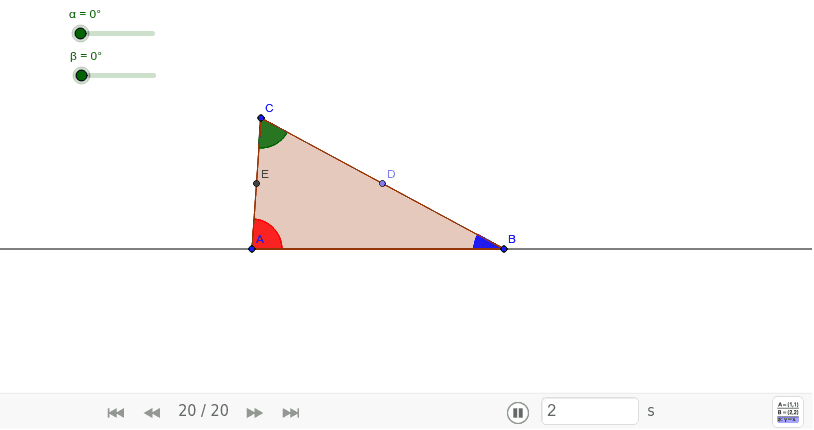
This example demonstrates the construction of rotating triangles to show the invariance of the sum of angles in a triangle. Key mathematical concepts include the angle sum theorem of a triangle. It uses commands like Line, Polygon, Angle, Midpoint, and Rotate in GeoGebra. Suitable for middle school and above students to learn about geometric transformations and triangle properties.
GeoGebra Commands & Parameters
Line(A, B) → aPolygon(A, B, C) → poly1, c, a_1, bAngle(poly1) → γ, δ, εMidpoint(B, C) → DRotate(A, (-α), D) → A'Rotate(B, (-α), D) → B'Rotate(C, (-α), D) → C'Polygon(A', B', C') → poly1', c', a', b'Angle(poly1') → ζ, η, θMidpoint(b') → ERotate(A', (-β), E) → A''Rotate(B', (-β), E) → B''Rotate(C', (-β), E) → C''Polygon(A'', B'', C'') → poly1'', c'', a'', b''Angle(poly1'') → ι, κ, λ
AI Drawing Prompt Reference
Draw triangle ABC, then rotate it around point D to form triangle A'B'C'. Next, rotate A'B'C' around point E to form the final triangle A''B''C''. Observe and demonstrate the invariance of the sum of angles in a triangle.
The prompt above was compiled from the original drawing commands and is for reference only.