
Rose and Lavender Oil Varying Proportionally
Loading the math board and drawing, please wait…
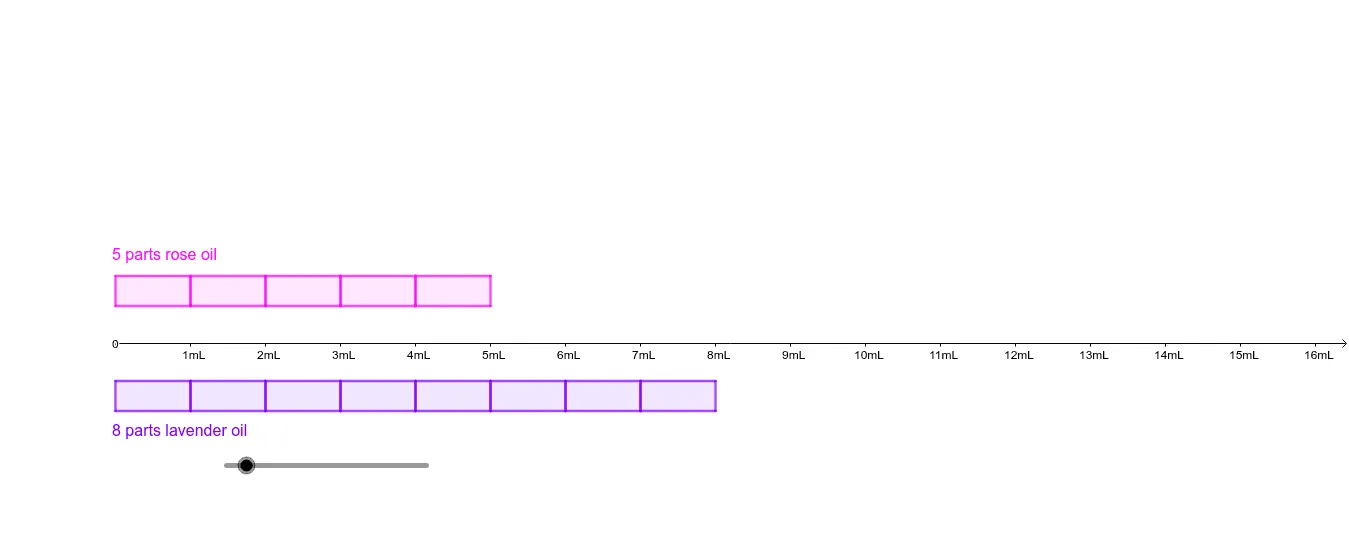
This example demonstrates the proportional relationship between rose and lavender oil. It involves key mathematical concepts such as proportion. Using GeoGebra commands like Intersect, Circle, and Line, the proportional changes can be visually represented. Suitable for middle school and above students to learn about proportion and geometric construction.
GeoGebra Commands & Parameters
Intersect(xAxis, yAxis) → ACircle(A, 0.5) → cIntersect(c, yAxis, 2) → BIntersect(c, yAxis, 1) → CLine(B, xAxis) → fLine(C, xAxis) → gCircle(B, 0.4) → dCircle(C, 0.4) → eIntersect(d, yAxis, 2) → DIntersect(e, yAxis, 1) → ELine(D, f) → hLine(E, g) → iCircle(E, a) → kIntersect(k, i, 2) → FCircle(F, a) → pIntersect(p, i, 2) → GCircle(G, a) → qIntersect(q, i, 2) → HCircle(H, a) → rIntersect(r, i, 2) → ICircle(I, a) → sIntersect(s, i, 2) → JCircle(J, a) → tIntersect(t, i, 2) → KCircle(K, a) → c_1Intersect(c_1, i, 2) → LCircle(L, a) → d_1Intersect(d_1, i, 2) → MOrthogonalLine(F, i) → jOrthogonalLine(G, i) → lOrthogonalLine(H, i) → mOrthogonalLine(I, i) → nOrthogonalLine(J, i) → bOrthogonalLine(K, i) → f_1OrthogonalLine(L, i) → g_1OrthogonalLine(M, i) → h_1Intersect(g, j) → NIntersect(f, j) → OIntersect(h, j) → PIntersect(g, l) → QIntersect(g, m) → RIntersect(g, n) → SIntersect(g, b) → TIntersect(g, f_1) → UIntersect(g, g_1) → VIntersect(g, h_1) → WIntersect(f, l) → ZIntersect(h, l) → A_1Intersect(f, m) → B_1Intersect(h, m) → C_1Intersect(f, n) → D_1Intersect(h, n) → E_1Intersect(f, b) → F_1Intersect(h, b) → G_1Polygon(B, O, P, D) → q1, b_1, o, p_1, d_2Polygon(O, Z, A_1, P) → q2, o_1, z_1, a_1, p_2Polygon(Z, B_1, C_1, A_1) → q3, z_2, b_2, c_2, a_2Polygon(B_1, D_1, E_1, C_1) → q4, b_3, d_3, e_1, c_3Polygon(D_1, F_1, G_1, E_1) → q5, d_4, f_2, g_2, e_2Polygon(E, F, N, C) → q6, e_3, f_3, n_1, c_4Polygon(F, G, Q, N) → q7, f_4, g_3, q_1, n_2Polygon(G, H, R, Q) → q8, g_4, h_2, r_1, q_2Polygon(H, I, S, R) → q9, h_3, i_1, s_1, r_2Polygon(I, J, T, S) → q10, i_2, j_1, t_1, s_2Polygon(J, K, U, T) → q11, j_2, k_1, u, t_2Polygon(K, L, V, U) → q12, k_2, l_1, v, u_1Polygon(L, M, W, V) → q13, l_2, m_1, w, v_1
AI Drawing Prompt Reference
Draw a coordinate system with a circle centered at the origin with radius 0.5. Intersect this circle with the y-axis at y=1 and y=2, draw lines from these points to the x-axis, and create circles with radius 0.4 centered at these intersection points. Repeat this process, drawing lines and circles to show proportional relationships, creating a series of intersecting lines and concentric circles.
The prompt above was compiled from the original drawing commands and is for reference only.