
A Variable-Parts Perspective on Trigonometry
Loading the math board and drawing, please wait…
In collections
The variable-parts perspective across the curriculum
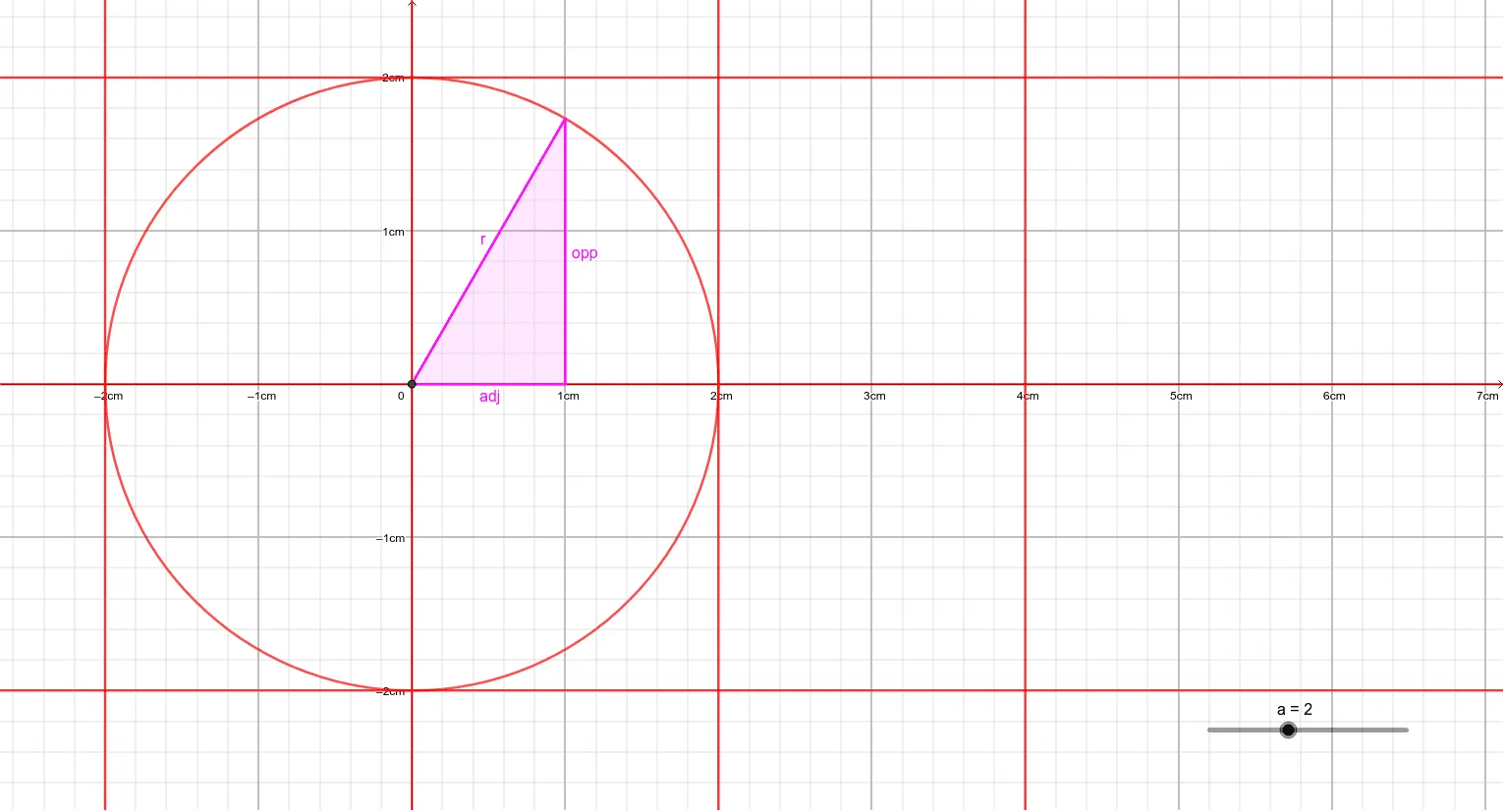
This example dynamically demonstrates the relationship between similar triangles and trigonometric functions from a variable-parts perspective, revealing geometric principles. Core math concepts include similar triangles, trigonometry, angles, coordinates, cones, stochastic processes, etc. Construction highlights are derived from GeoGebra commands: Intersect, Circle, Line, Midpoint, Polygon, Segment. Suitable for high school and above learners to understand the geometric foundation and dynamic changes of trigonometric functions.
GeoGebra Commands & Parameters
Intersect(xAxis, yAxis) → ACircle(A, a) → cLine(A, xAxis) → fLine(A, yAxis) → gIntersect(g, yAxis) → BIntersect(g, yAxis) → CIntersect(c, g) → D, EIntersect(c, f, 2) → FIntersect(c, f, 1) → GLine(F, g) → hLine(G, g) → iLine(E, f) → jLine(D, f) → kIntersect(i, j) → HIntersect(h, j) → IIntersect(h, k) → JIntersect(i, k) → KCircle(F, a) → dCircle(E, a) → eIntersect(e, g, 2) → LIntersect(d, f, 2) → MLine(M, h) → lLine(L, j) → mIntersect(i, m) → NIntersect(h, m) → OIntersect(l, m) → PIntersect(j, l) → QIntersect(k, l) → RMidpoint(A, F) → SLine(S, g) → nIntersect(c, n) → T, UPolygon(A, S, U) → t1, u, a_1, sSegment(A, U) → pSegment(A, S) → qSegment(S, U) → rSegment(U, A) → tCircle(G, a) → c_1Circle(D, a) → d_1Intersect(c_1, f, 1) → VIntersect(d_1, g, 1) → WLine(V, i) → bLine(W, k) → f_1
AI Drawing Prompt Reference
Draw a circle centered at the origin with two perpendicular axes. From the center, draw rays along both axes intersecting the circle at four points. Through these intersection points, draw lines parallel to the opposite axis, forming two sets of parallel lines that enclose a rectangle. Then, using adjacent circle points as centers and the original radius, draw two new circles. These new circles intersect the axes and parallel lines, creating more points. Connect these points to form additional segments and triangles. Finally, take the midpoint of a radius, draw a line through it parallel to the vertical axis, intersect with the circle, and connect the center, midpoint, and this intersection to form a right triangle, labeling its three sides. The overall figure illustrates the relationship between similar triangles and trigonometric functions.
The prompt above was compiled from the original drawing commands and is for reference only.