
Interpreting Points on a Coordinate Plane
Loading the math board and drawing, please wait…
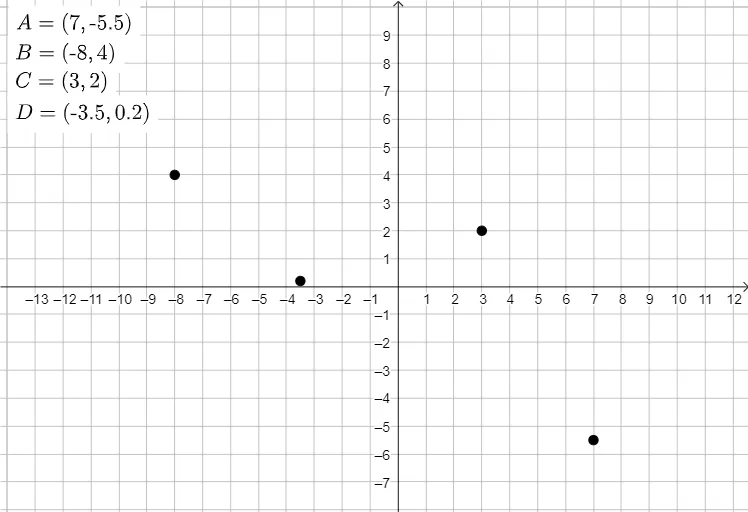
This example demonstrates how to read and interpret points on a coordinate plane and connect their coordinates to concrete geometric relationships. By placing points and highlighting their positions, learners see how coordinate values translate into measurable quantities such as distances and angle relationships. The key math concepts include interpreting ordered pairs in 2D coordinate geometry, understanding horizontal/vertical changes between points, relating point-to-point distance to the Pythagorean Theorem, and forming angles from the positions of points. In the construction, the text objects (text1, text2, text3, text4) provide labels and instructional prompts for coordinate reading, while the points A, B, C, and D serve as the geometric anchors used to build the relevant segments/figures and to interpret the resulting geometric quantities. Suitable for middle school through early high school, it works well for classroom demonstrations and practice on coordinate reading and basic coordinate-geometry reasoning.
GeoGebra Commands & Parameters
(7, -5.5)(-8, 4)(3, 2)(-3.5, 0.2)
AI Drawing Prompt Reference
Draw four points on a coordinate plane at (7, -5.5), (-8, 4), (3, 2), and (-3.5, 0.2). Connect these points to form line segments and label their positions. Observe the distances and angles between the points to understand the relationship between coordinates and geometry.
The prompt above was compiled from the original drawing commands and is for reference only.