
Rational and Irrational Solutions: Algebra 1 Unit 7 Lesson 20
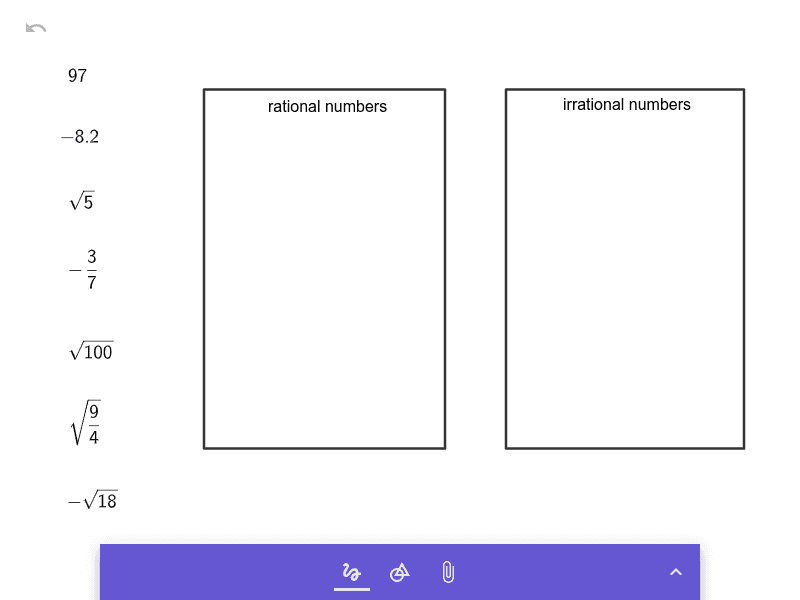
Loading the math board and drawing, please wait…
This example demonstrates how to distinguish rational and irrational solutions of quadratic equations using graphical and algebraic methods, and how the discriminant relates to the nature of the roots. Core mathematical concepts include quadratic equations, the discriminant, rational vs. irrational numbers, perfect squares, and radical simplification. Construction notes: although no specific GeoGebra commands are provided in the summary, typical construction involves graphing a quadratic function (e.g., y=ax²+bx+c) with sliders for coefficients, using the discriminant Δ=b²-4ac to determine whether solutions are rational (when Δ is a perfect square) or irrational (when Δ is positive but not a perfect square), and possibly displaying the solution formulas as text. Suitable for upper middle school or high school Algebra 1 courses, this activity helps students visually and conceptually understand the classification of quadratic solutions and can be used as an inquiry-based exploration.
AI Drawing Prompt Reference
Draw a quadratic function graph with coefficient sliders to show different function images by changing the sliders. Use the discriminant Δ=b²-4ac to determine the nature of the roots, displaying rational roots when Δ is a perfect square and irrational roots when Δ is positive but not a perfect square, with different colors or markers. Annotate the value of the discriminant and the corresponding root type on the graph to help understand the relationship between the discriminant and the roots.
The prompt above was compiled from the original drawing commands and is for reference only.