
Roots of a Complex Number: Geometric Construction of Unit Roots
Loading the math board and drawing, please wait…
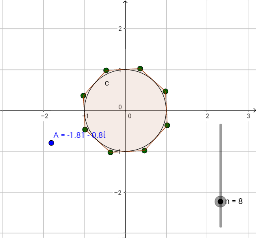
① This GeoGebra example dynamically visualizes the roots of unity on the complex plane, showing that the n-th roots of unity form the vertices of a regular n-gon. ② Core mathematical concepts include polar form of complex numbers, De Moivre's formula, solving z^n=1, and the geometric interpretation of complex multiplication as rotation. ③ Construction details: uses Sequence to generate equally spaced points, Intersect to find intersections with the unit circle, Circle to draw the unit circle, and Polygon to connect adjacent roots into a regular polygon; key objects include point A, integer n, complex number z_1, list1, intersection point B, circle c, and polygon poly1. ④ Suitable for high school to early college students learning complex numbers, offering an intuitive geometric approach to roots of unity, regular polygons, and the relationship between algebra and geometry.
GeoGebra Commands & Parameters
Sequence(Rotate[z_1, (((a * 2) * π)) / n], a, 1, n) → list1Intersect(xAxis, yAxis) → BCircle(B, 1) → cPolygon(Element[list1, 1], Element[list1, 2], n) → poly1
AI Drawing Prompt Reference
Visualize the geometric construction of the n-th roots of unity on the complex plane, showing they form the vertices of a regular n-gon. Draw a unit circle, then generate n equally spaced points starting from a complex number z_1 by rotating it at angles of 2π/n. The points where these radii intersect the unit circle are connected to form a regular polygon, illustrating the rotational interpretation of complex multiplication and the symmetry of roots of unity.
The prompt above was compiled from the original drawing commands and is for reference only.