
Representations of Sequences
Loading the math board and drawing, please wait…
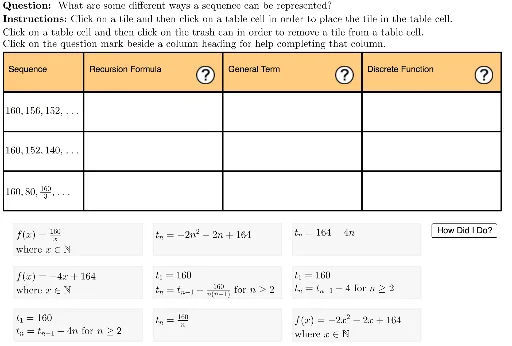
This example demonstrates different representations of sequences. Key mathematical concepts include sequences and series. Using GeoGebra commands such as Sequence, Flatten, and Shuffle, the example constructs recursive formulas, general terms, and scatter plots. Suitable for high school mathematics education and learning.
GeoGebra Commands & Parameters
Sequence(Polygon[{tableAnchor + (col1Width + col2Width + col3Width, 0 - (rowHeight * i)), tableAnchor + (col1Width + col2Width + col3Width + col4Width, 0 - (rowHeight * i)), tableAnchor + (col1Width + col2Width + col3Width + col4Width, 0 - (rowHeight * i) - rowHeight), tableAnchor + (col1Width + col2Width + col3Width, ((-rowHeight) * i) - rowHeight)}], i, 0, lastRow - 1) → tableCol4Sequence(Polygon[{tableAnchor + (col1Width + col2Width, 0 - (rowHeight * i)), tableAnchor + (col1Width + col2Width + col3Width, 0 - (rowHeight * i)), tableAnchor + (col1Width + col2Width + col3Width, 0 - (rowHeight * i) - rowHeight), tableAnchor + (col1Width + col2Width, ((-rowHeight) * i) - rowHeight)}], i, 0, lastRow - 1) → tableCol3Sequence(Polygon[{tableAnchor + (col1Width, 0 - (rowHeight * i)), tableAnchor + (col1Width + col2Width, 0 - (rowHeight * i)), tableAnchor + (col1Width + col2Width, 0 - (rowHeight * i) - rowHeight), tableAnchor + (col1Width, ((-rowHeight) * i) - rowHeight)}], i, 0, lastRow - 1) → tableCol2Flatten(Sequence[Sequence[(i, j), i, -8, -8 + (2 * (tileWidth + 1)), tileWidth + 1], j, 3, 3 - (2 * (tileHeight + 1)), (-tileHeight) - 1]) → fixedFrameAnchorsShuffle(fixedFrameAnchors) → shuffledFrameAnchorsLaTeX(UnicodeToLetter[10003]) → cmarkLaTeX(UnicodeToLetter[10007]) → xmarkSequence(Polygon[{tableAnchor + (0, 0 - (rowHeight * i)), tableAnchor + (col1Width, 0 - (rowHeight * i)), tableAnchor + (col1Width, 0 - (rowHeight * i) - rowHeight), tableAnchor + (0, ((-rowHeight) * i) - rowHeight)}], i, 0, lastRow - 1) → tableCol1LaTeX((((("\text{" * QUESTION) * "\\") * INSTRUCTIONS) * "}")) → TEXTText("Recursion Formula", tableAnchor + (0.5 + col1Width, ((-rowHeight)) / 2)) → col2HeaderText("General Term", tableAnchor + (0.5 + col1Width + col2Width, ((-rowHeight)) / 2)) → col3HeaderText("Discrete Function", tableAnchor + (0.5 + col1Width + col2Width + col3Width, ((-rowHeight)) / 2)) → col4HeaderText("160, 156, 152, \ldots", tableAnchor + (0, (-rowHeight) - rowHeight / 3), true, true) → sequence1Text("160, 80, \tfrac{160}{3}, \ldots", tableAnchor + (0, ((-rowHeight) * 3) - rowHeight / 3), true, true) → sequence3Text("160, 152, 140, \ldots", tableAnchor + (0, ((-rowHeight) * 2) - rowHeight / 3), true, true) → sequence2Zip(Polygon[A, A + (tileWidth, 0), A + (tileWidth, (-tileHeight)), A + (0, (-tileHeight))], A, shuffledFrameAnchors) → framesElement(frames, 1) → frame1Element(frames, 2) → frame2Element(frames, 3) → frame3Element(frames, 4) → frame4Element(frames, 5) → frame5Element(frames, 6) → frame6Element(frames, 7) → frame7Element(frames, 8) → frame8Element(frames, 9) → frame9Element(cells, 1) → cell1Element(frames, activeTile) → highlightedTileElement(cells, 2) → cell2Element(cells, 3) → cell3Element(cells, 4) → cell4Element(cells, 5) → cell5Element(cells, 7) → cell7Element(cells, 8) → cell8Element(cells, 9) → cell9Element(cells, activeCell) → highlightedCellElement(tableCol1, 1) → col1HeaderCellText("Sequence", tableAnchor + (0.5, ((-rowHeight)) / 2)) → col1HeaderElement(tableCol2, 1) → col2HeaderCellElement(tableCol3, 1) → col3HeaderCellElement(tableCol4, 1) → col4HeaderCellElement(cells, 6) → cell6Zip(A ≟ B, A, itemsInCells, B, 1…9) → cellsCorrectZip(Text[If[A, cmark, ""], Vertex[B, 2] + symbolOffset], A, cellsCorrect, B, cells) → cmarkListZip(Text[If[¬A, xmark, ""], Vertex[B, 2] + symbolOffset], A, cellsCorrect, B, cells) → xmarkListLaTeX("\text{You found three different algebraic representations for each sequence.}") → feedback
AI Drawing Prompt Reference
Draw multiple representations of sequences, including recursive formulas, general terms, and discrete functions. Start by drawing a table with four columns: recursive formulas, general terms, discrete functions, and sequences. Then input three sequences: 160, 156, 152, ...; 160, 80, 160/3, ...; 160, 152, 140, .... Next, draw nine blocks below the table to represent the terms of the sequences, and mark the current term with different colors. Finally, add titles above the table: recursive formulas, general terms, discrete functions, and sequences.
The prompt above was compiled from the original drawing commands and is for reference only.