
Regular Pentagon to a Square Dissection
Loading the math board and drawing, please wait…
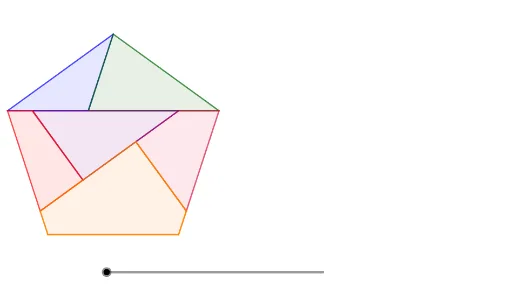
① This example demonstrates how to dissect a regular pentagon and rearrange the pieces via translation to form a square of equal area, illustrating an area-preserving transformation. ② Core mathematical concepts include polygon dissection, area conservation, translation transformations, and geometric construction; it relates the side lengths of a regular pentagon and a square, combining geometric intuition with algebraic reasoning. ③ Construction highlights: Based on the construction summary, GeoGebra commands such as Point, Polygon, Segment, Intersect, OrthogonalLine, Midpoint, Circle, Line, If, Vector, and Translate are used, creating multiple auxiliary points, lines, circles, and vectors. The dissection pieces are translated to form the square, involving objects like A, B, poly1, f, g, h, i, j, C, D, E, and many auxiliary lines and circles. ④ Suitable for middle/high school geometry, math competitions, or teacher training on geometric transformations, useful for exploring equal-area dissections and dynamic geometry demonstrations.
GeoGebra Commands & Parameters
Point(xAxis) → APoint(xAxis) → BPolygon(A, B, 5) → poly1, f, g, h, i, j, C, D, ESegment(E, C) → kSegment(D, A) → lIntersect(k, l) → FOrthogonalLine(D, f) → mIntersect(m, f) → GSegment(D, G) → nMidpoint(n) → HOrthogonalLine(C, f) → pCircle(C, Segment[H, G]) → cIntersect(c, p, 1) → IOrthogonalLine(I, p) → qIntersect(q, j) → JOrthogonalLine(J, q) → rSegment(A, C) → sLine(J, s) → tIntersect(t, k) → KIntersect(q, g) → LOrthogonalLine(L, s) → aIntersect(t, a) → MPolygon(E, D, F) → t1, f_1, e, dPolygon(F, D, C) → t2, c_1, f_2, d_1Polygon(K, M, L, C) → q1, k_1, m_1, l_1, c_2Polygon(L, M, J, A, B) → poly2, l_2, m_2, j_1, a_1, bCircle(K, Segment[J, L]) → e_1Intersect(e_1, k, 1) → NOrthogonalLine(N, t) → g_1Intersect(t, g_1) → OPolygon(N, O, K) → t3, k_2, n_1, oPolygon(E, N, O, J) → q2, e_2, n_2, o_1, j_2OrthogonalLine(D, yAxis) → h_1Point(h_1) → PIf(0 ≤ u < 1, Dilate[M, 1 - u, P], P) → QVector(M, Q) → vTranslate(L, v) → L'Translate(M, v) → M'Translate(J, v) → J'Translate(A, v) → A'Translate(B, v) → B'Polygon(L', M', J', A', B') → poly2', l', m', j', a', b'If(2 ≤ u < 3, Dilate[C, 3 - u, B'], B') → RVector(C, R) → wTranslate(F, w) → F'Translate(D, w) → D'Translate(C, w) → C'Polygon(F', D', C') → t2', c', f', d'If(2 ≤ u < 3, Polygon[Rotate[F', (((u - 2) * 2) * π / 10), R], Rotate[D', (((u - 2) * 2) * π / 10), R], Rotate[C', (((u - 2) * 2) * π / 10), R]], Polygon[Rotate[F', (((3 - 2) * 2) * π / 10), R], Rotate[D', (((3 - 2) * 2) * π / 10), R], Rotate[C', (((3 - 2) * 2) * π / 10), R]]) → t4If(2 ≤ u < 3, Rotate[F', (((u - 2) * 2) * π / 10), R], Rotate[F', (((3 - 2) * 2) * π / 10), R]) → SIf(4 ≤ u < 5, Dilate[L, 5 - u, L'], L') → TVector(L, T) → u_1If(4 ≤ u < 5, Rotate[Polygon[Translate[K, u_1], Translate[M, u_1], Translate[L, u_1], Translate[C, u_1]], ((u - 4) * π), T], Rotate[Polygon[Translate[K, u_1], Translate[M, u_1], Translate[L, u_1], Translate[C, u_1]], π, T]) → q3If(4 ≤ u < 5, Rotate[Translate[K, u_1], ((u - 4) * π), T], Rotate[Translate[K, u_1], π, T]) → UIf(6 ≤ u < 7, Dilate[E, 7 - u, S], S) → VVector(E, V) → v_1If(6 ≤ u < 7, Polygon[Translate[E, v_1], Translate[D, v_1], Translate[F, v_1]], Polygon[Translate[E, v_1], Translate[D, v_1], Translate[F, v_1]]) → t5If(8 ≤ u < 9, Dilate[K, 9 - u, U], U) → WVector(K, W) → w_1If(8 ≤ u < 9, Polygon[Translate[N, w_1], Translate[O, w_1], Translate[K, w_1]], Polygon[Translate[N, w_1], Translate[O, w_1], Translate[K, w_1]]) → t6If(10 ≤ u ≤ 11, Dilate[J, 11 - u, J'], J') → ZVector(J, Z) → b_1If(10 ≤ u ≤ 11, Rotate[Polygon[Translate[E, b_1], Translate[N, b_1], Translate[O, b_1], Translate[J, b_1]], ((u - 10) * π), Z], Rotate[Polygon[Translate[E, b_1], Translate[N, b_1], Translate[O, b_1], Translate[J, b_1]], ((11 - 10) * π), Z]) → q4
AI Drawing Prompt Reference
Draw a regular pentagon and demonstrate how to dissect it into pieces and rearrange them via translation to form a square of equal area. Start by constructing the pentagon, then identify key points and draw auxiliary lines, circles, and vectors. Dissect the pentagon into several parts, and show how translating these pieces forms a new square, ensuring area conservation throughout the transformation process.
The prompt above was compiled from the original drawing commands and is for reference only.