
Reflecting a Triangle Over a Line
Loading the math board and drawing, please wait…
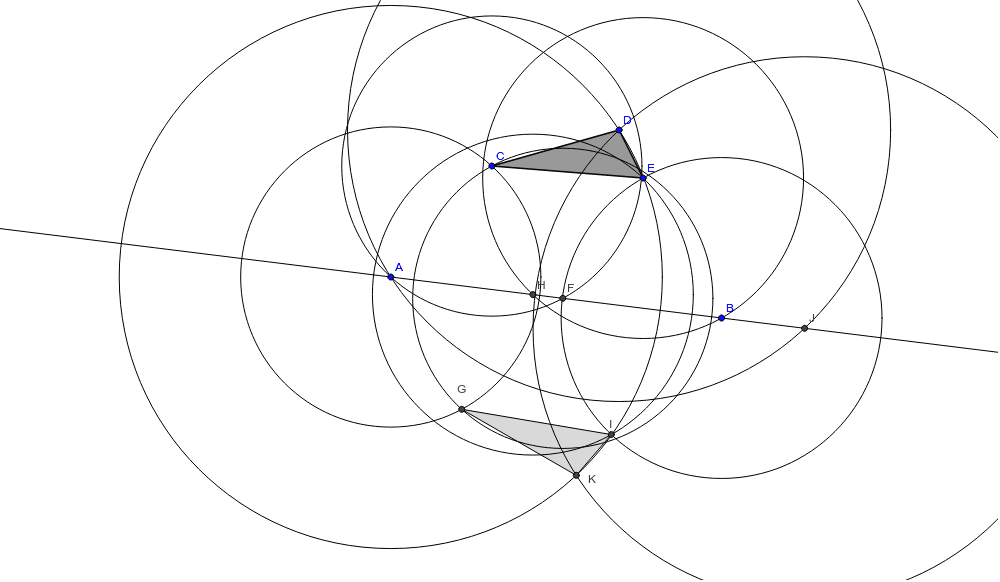
This example demonstrates how to reflect a triangle over a line, illustrating key math concepts like geometric transformations, symmetry, and congruence. It uses GeoGebra commands such as Line, Polygon, Circle, and Intersect for construction. Ideal for high school students learning geometric transformations and constructions.
GeoGebra Commands & Parameters
Line(A, B) → aPolygon(C, D, E) → poly1, e, c, dCircle(C, Segment[C, A]) → fIntersect(f, a, 2) → FCircle(F, Segment[A, C]) → gCircle(A, Segment[A, C]) → hIntersect(g, h, 1) → GCircle(E, Segment[E, B]) → kIntersect(k, a, 1) → HCircle(B, Segment[E, B]) → pCircle(H, Segment[E, B]) → qIntersect(p, q, 1) → ICircle(D, Segment[D, A]) → rIntersect(r, a, 2) → JCircle(J, Segment[J, D]) → sCircle(A, Segment[D, J]) → tIntersect(s, t, 1) → KPolygon(G, I, K) → poly2, k_1, g_1, i
AI Drawing Prompt Reference
Draw a triangle and a line. With one vertex of the triangle as the center, draw a circle with a radius equal to the distance from the vertex to the line. The circle intersects the line at two points. Repeat this process for the other two vertices, using the intersection points as centers for new circles. Connect the three new intersection points to form the reflected triangle, and include all auxiliary circles and lines.
The prompt above was compiled from the original drawing commands and is for reference only.