
Exploring the Link Between a Sequence and a Function
Loading the math board and drawing, please wait…
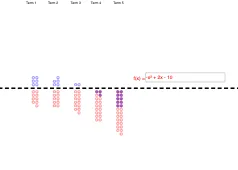
This example visually investigates how a sequence relates to a function by constructing and comparing sequence terms with corresponding function values on the same GeoGebra workspace. It highlights key ideas such as sequences (the terms S_1, S_2, … generated by a rule), functions (mapping from inputs to outputs, possibly via conditional or piecewise definitions), and term-by-term computation driven by user-provided parameters. Construction uses GeoGebra commands including Line for graphical/auxiliary relationships, If for conditional logic to define the rule behind the sequence/function behavior, and Textfield/Text to label parameters and results (e.g., a, b, c, and text blocks). An InputBox1 provides inputs that drive computed objects like F_1…F_10 and S_1…S_10, while horizontalLine and other created elements support clear comparison. Suitable for secondary to early university settings in algebra, function modeling, and interactive mathematical exploration.
GeoGebra Commands & Parameters
Line(A, B) → horizontalLineIf(s(1) ≥ 0, Sequence[Circle[(Mod[n, 2], floor(n / 2 + 0.5)), 0.3], n, 1, s(1)]) → S_1If(s(1) < 0, Sequence[Circle[(Mod[abs(n), 2], (-floor(abs(n) / 2 + 0.5))), 0.3], n, -1, s(1), -1]) → S_2If(s(2) ≥ 0, Sequence[Circle[(Mod[n, 2] + 6, floor(n / 2 + 0.5)), 0.3], n, 1, s(2)]) → S_3If(s(3) ≥ 0, Sequence[Circle[(Mod[n, 2] + 12, floor(n / 2 + 0.5)), 0.3], n, 1, s(3)]) → S_4If(s(4) ≥ 0, Sequence[Circle[(Mod[n, 2] + 18, floor(n / 2 + 0.5)), 0.3], n, 1, s(4)]) → S_5If(s(5) ≥ 0, Sequence[Circle[(Mod[n, 2] + 24, floor(n / 2 + 0.5)), 0.3], n, 1, s(5)]) → S_6If(s(2) < 0, Sequence[Circle[(Mod[abs(n), 2] + 6, (-floor(abs(n) / 2 + 0.5))), 0.3], n, -1, s(2), -1]) → S_7If(s(3) < 0, Sequence[Circle[(Mod[abs(n), 2] + 12, (-floor(abs(n) / 2 + 0.5))), 0.3], n, -1, s(3), -1]) → S_8If(s(4) < 0, Sequence[Circle[(Mod[abs(n), 2] + 18, (-floor(abs(n) / 2 + 0.5))), 0.3], n, -1, s(4), -1]) → S_9If(s(5) < 0, Sequence[Circle[(Mod[abs(n), 2] + 24, (-floor(abs(n) / 2 + 0.5))), 0.3], n, -1, s(5), -1]) → S_{10}Textfield(f) → InputBox1If(f(1) ≥ 0, Sequence[Circle[(Mod[n, 2], floor(n / 2 + 0.5)), 0.3], n, 1, f(1)]) → F_1If(f(1) < 0, Sequence[Circle[(Mod[abs(n), 2], (-floor(abs(n) / 2 + 0.5))), 0.3], n, -1, f(1), -1]) → F_2If(f(2) ≥ 0, Sequence[Circle[(Mod[n, 2] + 6, floor(n / 2 + 0.5)), 0.3], n, 1, f(2)]) → F_3If(f(3) ≥ 0, Sequence[Circle[(Mod[n, 2] + 12, floor(n / 2 + 0.5)), 0.3], n, 1, f(3)]) → F_4If(f(4) ≥ 0, Sequence[Circle[(Mod[n, 2] + 18, floor(n / 2 + 0.5)), 0.3], n, 1, f(4)]) → F_5If(f(5) ≥ 0, Sequence[Circle[(Mod[n, 2] + 24, floor(n / 2 + 0.5)), 0.3], n, 1, f(5)]) → F_6If(f(2) < 0, Sequence[Circle[(Mod[abs(n), 2] + 6, (-floor(abs(n) / 2 + 0.5))), 0.3], n, -1, f(2), -1]) → F_7If(f(3) < 0, Sequence[Circle[(Mod[abs(n), 2] + 12, (-floor(abs(n) / 2 + 0.5))), 0.3], n, -1, f(3), -1]) → F_8If(f(4) < 0, Sequence[Circle[(Mod[abs(n), 2] + 18, (-floor(abs(n) / 2 + 0.5))), 0.3], n, -1, f(4), -1]) → F_9If(f(5) < 0, Sequence[Circle[(Mod[abs(n), 2] + 24, (-floor(abs(n) / 2 + 0.5))), 0.3], n, -1, f(5), -1]) → F_{10}
AI Drawing Prompt Reference
On the same coordinate plane, first draw a horizontal reference line and add an editable text input for the parameter. Construct two sequences of circles with terms S1 through S10 and F1 through F10. Each term is generated from a piecewise rule: for S1–S10, decide for each k (1–5) whether sk is nonnegative or negative, then place the circle centers using a discrete x-position based on n’s parity (via Mod[n,2]) with an offset depending on k (0, 6, 12, 18, 24), while the y-position is determined by floor(n/2 + 0.5); the negative case uses the corresponding mirrored/abs-based x and opposite sign in the y formula as reflected in the rule. Repeat the same logic for F1–F10 using f(k), so both sequences can be visually compared term-by-term on the same workspace to explore how a sequence relates to a function.
The prompt above was compiled from the original drawing commands and is for reference only.