
Quiz: Constructing a Line with a Given Slope Using Δy/Δx
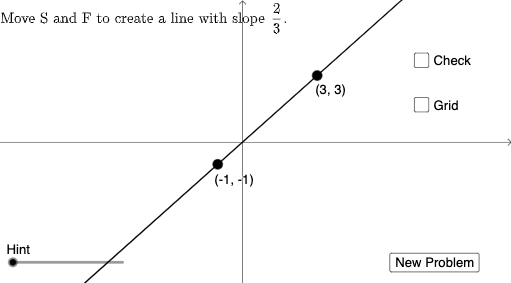
Loading the math board and drawing, please wait…
This example, presented as a quiz, demonstrates how to construct a line with a specified slope on the coordinate plane starting from a chosen point, using the idea that slope is the ratio of changes Δy/Δx. It focuses on slope as a difference-and-ratio quantity, how to determine the direction of a line, and how the intercept-related parameters can be represented with simplified fractions. The construction uses GeoGebra commands such as Line and Segment to build the geometric entities, Slope and Angle (plus Distance) to measure and confirm slope and geometric relations, OrthogonalLine together with Intersect to obtain key perpendicular/meeting points, Vector and Midpoint to work with direction and central points, Dilate for scaling, and Mirror for reflections when needed for comparative structure. FractionText and fraction-related text objects display the computed numerator/denominator forms, while GCD and If support simplification of the slope ratio into reduced fractional values. Suitable for middle and high school learners to practice the geometric meaning of slope and its connection to coordinate-geometry reasoning.
GeoGebra Commands & Parameters
GCD(deltaY, deltaX) → GCDmGCD(numerYint, deltaX) → GCDyIf(sgn(deltaY / deltaX) ≥ 0, "", "-") → textSignNIf(sgn(numerYint / deltaX) > 0, "+", "-") → textSignIf(deltaXR ≟ 1, textSignN + deltaYR, textSignN + "\, \frac{" + deltaYR + "}{" + deltaXR + "}") → textslopeNIf(denomYintR ≟ 1, textSign + numerYintR, textSign + "\frac{" + numerYintR + "}{" + denomYintR + "}") → textYintIf(denomYintR ≟ 1, If[numerYintR ≟ 1, textSign, textSign + numerYintR], textSign + "\frac{" + numerYintR + "}{" + denomYintR + "}") → textMIDOrthogonalLine(B, xAxis) → a_2OrthogonalLine(A, yAxis) → cIntersect(a_2, c) → CLine(A, B) → dPolygon(A, B, C) → poly1, c_1, a_1, b_1Distance(B, C) → distanceBCDistance(A, C) → distanceACIntersect(a_2, c) → DSegment(A, D) → eSegment(C, B) → fGCD(deltaY_1, deltaX_1) → GCDm_1If(sgn(deltaY_1 / deltaX_1) ≥ 0, "", "-") → textSignN_1If(deltaXR_1 ≟ 1, textSignN_1 + deltaYR_1, textSignN_1 + "\, \frac{" + deltaYR_1 + "}{" + deltaXR_1 + "}") → textslopeN_1Line(A_1, B_1) → d_1Angle(B, D, A) → αSegment(A, B) → gGCD(deltaY_2, deltaX_2) → GCDm_2If(sgn(deltaY_2 / deltaX_2) ≥ 0, "", "-") → textSignN_2If(deltaXR_2 ≟ 1, textSignN_2 + deltaYR_2, textSignN_2 + "\, \frac{" + deltaYR_2 + "}{" + deltaXR_2 + "}") → textslopeN_2Line(A_2, B_2) → d_2Segment(A_2, B_2) → g_1GCD(deltaY_3, deltaX_3) → GCDm_3If(sgn(deltaY_3 / deltaX_3) ≥ 0, "", "-") → textSignN_3If(deltaXR_3 ≟ 1, textSignN_3 + deltaYR_3, textSignN_3 + "\, \frac{" + deltaYR_3 + "}{" + deltaXR_3 + "}") → textslopeN_3Line(A_3, B_3) → d_3Segment(A_3, B_3) → g_2Slope(g) → hDilate(A, If[0 < i ≤ 1, 1 - i, 0], D) → A'Vector(A, A') → uDilate(D, If[1 < i ≤ 2, 2 - i, 0], B) → D'Vector(D, D') → vLine(A, B) → jMidpoint(A, C) → EMirror(B, k) → B'Distance(A, B') → distanceAB'Distance(B', B) → distanceB'BPolygon(A, B', B) → t1, b_5, a_6, b'Dilate(A, If[0 < i ≤ 1, 1 - i, 0], B') → A'_1Vector(A, A'_1) → wDilate(B', If[1 < i ≤ 2, 2 - i, 0], B) → B''Vector(B', B'') → lIntersect(m, n) → FDilate(A, If[0 < i ≤ 1, 1 - i, 0], F) → A'_2Vector(A, A'_2) → pDilate(F, If[1 < i ≤ 2, 2 - i, 0], B) → F'Vector(F, F') → qDistance(A, F) → distanceAFDistance(F, B) → distanceFBPolygon(A, F, B) → t3, b_6, a_7, f_1FractionText(i_1) → text8Sequence(i, i, -10, 10, 1) → l1FractionText(m_1) → text1Dilate(pic1, 1 / 5, G) → pic1'Dilate(pic2, 1 / 5, I) → pic2'
AI Drawing Prompt Reference
Draw a line with a positive slope starting from the origin. First, draw the x-axis and y-axis. Then, select points A and B in the first quadrant, ensuring B is above and to the right of A. Draw a line d through points A and B and calculate its slope. Adjust the positions of points A and B to observe the change in slope and express it as a fraction. Finally, draw a line a_2 perpendicular to line d and find the intersection point C of lines d and a_2, forming a triangle.
The prompt above was compiled from the original drawing commands and is for reference only.