
Open Middle Perpendicular Bisector Problem
Loading the math board and drawing, please wait…
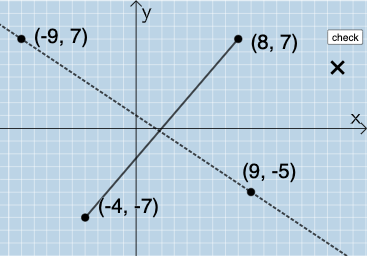
This example demonstrates the geometric construction and coordinate analysis of perpendicular bisectors. Key mathematical concepts include geometry, coordinates, lines, and isosceles triangles. Construction involves using commands like PointIn, Segment, Line, Intersect, and objects such as Midpoint, Dilate. Suitable for middle or high school mathematics education to understand geometric transformations and coordinate system applications.
GeoGebra Commands & Parameters
PointIn(j) → APointIn(j) → BPointIn(j) → CPointIn(j) → DSegment(A, B) → fLine(C, D) → gIntersect(g, f) → EAngle(B, E, C) → αMidpoint(f) → FIntersect(eq1, h) → GDilate(A, If[0 < b ≤ 1, 1 - b, 0], E) → A'Vector(A, A') → uTranslate(A, u) → A'_{1}Translate(G, u) → G'Translate(E, u) → E'Rotate(A'_{1}, If[1 < b ≤ 2, ((b - 1) * π / 2), π / 2], E) → HRotate(E', If[1 < b ≤ 2, ((b - 1) * π / 2), π / 2], E) → E''Rotate(A'_{1}, If[1 < b ≤ 2, ((b - 1) * π / 2), π / 2], E) → IRotate(G', If[1 < b ≤ 2, ((b - 1) * π / 2), π / 2], E) → G''Rotate(E', If[1 < b ≤ 2, ((b - 1) * π / 2), π / 2], E) → E''_{1}Rotate(B, If[1 < b ≤ 2, ((b - 1) * α), α], E) → B'Angle(B, E, B') → βMode(l1) → l2Length(l2) → aSegment(A, E) → lSegment(E, B) → mRotate(A, If[0 < b ≤ 1, ((-b) * π), (-π)], E) → A'_{2}Rotate(E, If[0 < b ≤ 1, ((-b) * π), (-π)], E) → E'_{1}Segment(A'_{2}, E'_{1}) → l'If(a ≟ 0, "√", "×") → text2
AI Drawing Prompt Reference
Create a coordinate-plane style diagram with two lines made from four given points. Choose two points to define one line segment and two other points to define a second line; let the two lines intersect at a central point. From the intersection, draw segments connecting to the endpoints of one line and construct the angle with that vertex between the two directions toward the endpoints. Take the midpoint of the first segment and use it with the intersection geometry to form a related point. Then obtain several corresponding points by applying translations (shifting all relevant points by the same displacement vector) and rotations around the intersection by right-angle–type and parameter-dependent angles. Finally, draw the key segments from the intersection to the corresponding endpoints and construct the resulting angles between the rotated rays to reflect the perpendicular-bisector/isoceles-triangle structure.
The prompt above was compiled from the original drawing commands and is for reference only.