
Quarter Circle Surprise
Loading the math board and drawing, please wait…
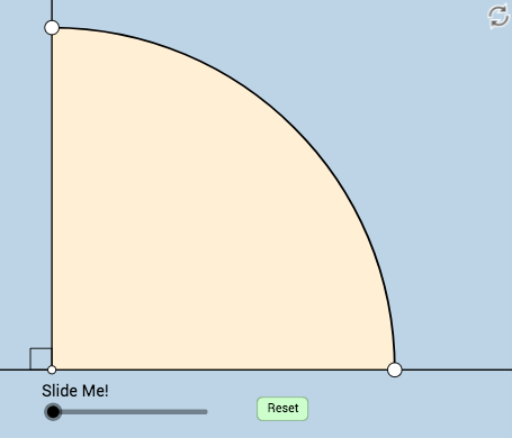
This dynamic illustration demonstrates the relationship between angles, lines, and probability & statistics problems within a quarter circle. It involves core math concepts like angles, circles, hypothesis testing, conditional probability, median value, geometric transformations, and indefinite integrals. The construction leverages GeoGebra commands such as Circle, Rotate, Angle, Line, Intersect, Ray, Segment, CircleSector, CircleArc, Dilate, Point, and Polygon. It is suitable for high school and above students to explore the integration of geometric transformations and probability statistics.
GeoGebra Commands & Parameters
Circle(A, B) → cRotate(B, 45°, A) → B'Angle(B, A, B') → αLine(B', f) → hLine(B', g) → iIntersect(f, xAxis) → DIntersect(i, f) → EIntersect(g, h) → FLine(F, B) → jAngle(B, F, B') → βRotate(B', β, F) → B''Angle(B', F, B'') → γRay(F, B'') → kIntersect(c, k, 1) → GSegment(F, G) → lCircle(F, (0.5 * l)) → dIntersect(d, l, 1) → HIntersect(d, h, 2) → ICircleSector(F, I, H) → eCircle(A, (0.2 * a)) → pRay(A, B') → mIntersect(p, g) → J, KIntersect(p, f) → L, MIntersect(p, m, 1) → NCircleSector(A, N, J) → qAngle(C, A, O) → δAngle(B', E, O) → εRay(A, O) → nCircleArc(A, B, C) → rRay(A, B) → sRay(A, C) → tDilate(A, If[0 < o ≤ 1, 1 - o, 0], B') → A'Segment(A, A') → f_1Point(h) → PAngle(P, F, A) → ηRay(F, P) → g_1Dilate(B', If[1 < o ≤ 2, 2 - o, 0], E) → B''_1Dilate(B', If[1 < o ≤ 2, 2 - o, 0], F) → B''_2Segment(B', B''_1) → h_1Segment(B', B''_2) → i_1Rotate(q, If[2 < o ≤ 3, ((-(o - 2)) * π / 4), ((-π)) / 4], A) → q'Circle(F, l) → c_1Intersect(c_1, j, 2) → QCircle(Q, l) → d_1Intersect(d_1, j, 2) → RDilate(F, If[3 < o ≤ 4, 4 - o, 0], G) → F'Segment(F, F') → j_1Dilate(F, If[4 < o < 5, 5 - o, 0], Q) → F'_1Segment(F, F'_1) → k_1Dilate(Q, If[5 < o < 6, 6 - o, 0], R) → Q'Segment(Q, Q') → l_1Dilate(R, If[6 < o < 7, 7 - o, 0], B) → R'Segment(R, R') → m_1Rotate(e, If[7 < o ≤ 8, ((-(o - 7)) * β), (-β)], F) → e'Rotate(F, If[8 < o ≤ 9, (((-(o - 8)) * 2) * β), (-2 * β)], F) → F'_2Rotate(F', If[8 < o ≤ 9, (((-(o - 8)) * 2) * β), (-2 * β)], F) → F''Segment(F'_2, F'') → n_1Rotate(F'_2, If[9 < o ≤ 10, ((-(o - 9)) * π), (-π)], F'') → SRotate(F'', If[9 < o ≤ 10, ((-(o - 9)) * π), (-π)], F'') → F'''Segment(S, F''') → p_1Rotate(S, If[10 < o ≤ 11, ((-(o - 10)) * π), (-π)], S) → S'Rotate(F''', If[10 < o ≤ 11, ((-(o - 10)) * π), (-π)], S) → TSegment(S', T) → q_1Ray(A, U) → r_1CircleSector(A, B, C) → e_1Polygon(A, E, B', F) → poly1, a_1, e_2, b', f_2