
Quadrilateral Interior & Exterior Angle Sum Theorems (V2)
Loading the math board and drawing, please wait…
In collections
Polygons & Angles
Polygons & Angles
Polygons & Angles ( s n attar)
Polygons & Angles
Polygons & Angles
Polygons & Angles
Polygons & Angles
Geometry: Polygons & Angles
Geometry: Polygons & Angles
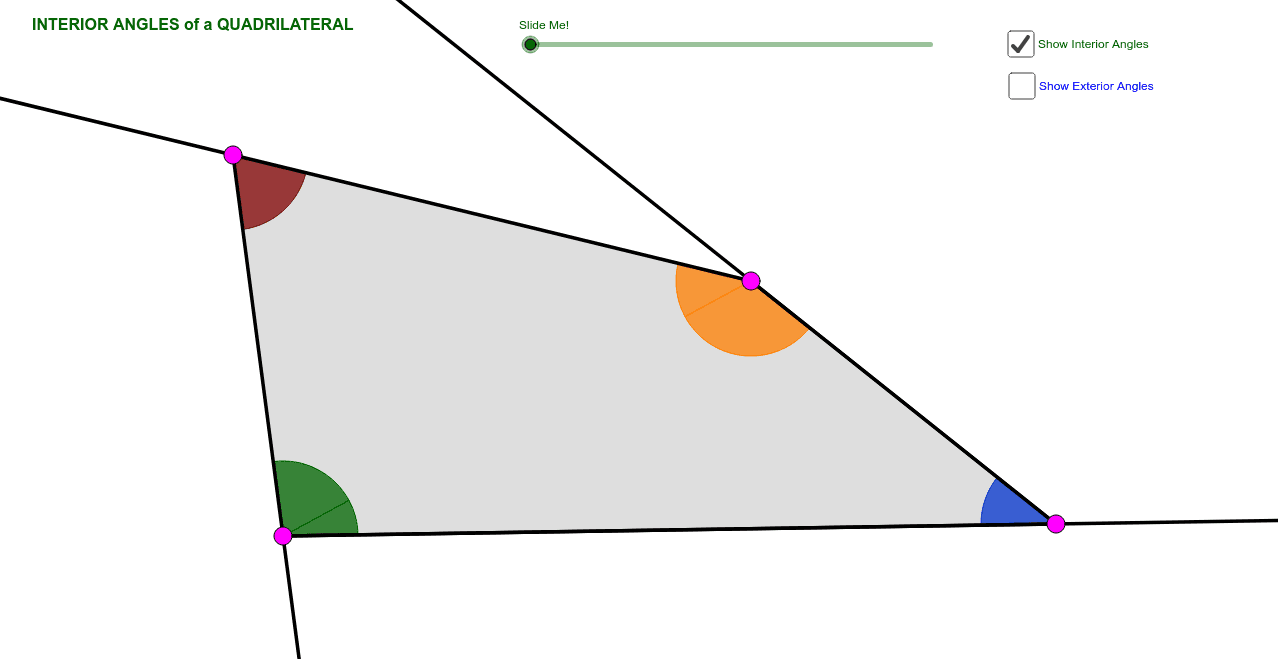
① This applet dynamically demonstrates that the sum of interior angles of any quadrilateral is always 360°, and that the sum of its exterior angles is also 360°. ② Core mathematical concepts: quadrilaterals, interior angles, exterior angles, angle sum theorems, polygon angle properties. ③ Construction highlights: the model is built with GeoGebra commands Ray, Point, Circle, Intersect, Segment, Angle, CircleSector, Vector, Translate, Dilate, If, Line, Polygon, Rotate, Mirror to create vertices, edges, rays, arcs, sectors, vectors, translations, dilations, conditional logic, rotations, and reflections, enabling interactive angle measurement and summation. ④ Suitable for middle‑school geometry (grades 7‑9) lessons on angles and polygons, for classroom demonstration, student exploration, and exam review.
GeoGebra Commands & Parameters
Ray(P, A) → h_1Point(h_1) → RRay(A, R) → j_1Ray(A, B) → aCircle(A, 1.5) → gIntersect(g, j_1) → I_1,Intersect(g, a, 1) → HSegment(P, A) → l_1Intersect(g, l_1, 1) → H_1Segment(P, C) → k_1Circle(C, 1.5) → kIntersect(k, k_1) → Z,Ray(B, C) → bIntersect(k, b) → M, NPoint(a) → D_1Point(b) → E_1Ray(B, D_1) → eRay(C, E_1) → fPoint(e) → DPoint(f) → EAngle(A, C, B) → γAngle(D, B, C) → εAngle(E, C, A) → ζCircle(B, 1.5) → hIntersect(h, b, 1) → JIntersect(h, a, 1) → KIntersect(h, a, 2) → LCircleSector(B, J, K) → qCircleSector(B, L, J) → tVector(B, C) → uCircleSector(A, I_1, H) → c_1Vector(A, C) → vTranslate(q, u) → q'Segment(B, C) → lDilate(C, If[0 < j ≤ 1, j, 0], B) → C'Vector(B, C') → wTranslate(q, w) → q'_1Dilate(A, If[1 < j ≤ 2, 2 - j, 0], C) → C'_1Vector(A, C'_1) → mDilate(C, If[0 < n ≤ 1, n, 0], B) → C'_2Dilate(A, If[1 < n ≤ 2, 2 - n, 0], C) → A'Vector(B, C'_2) → u_1Vector(A, A') → v_1If(0 < n ≤ 1, Translate[t, u_1], Translate[t, u]) → e_1If(1 < n ≤ 2, Translate[c_1, v_1], Translate[c_1, v]) → f_1Ray(C, P) → g_1Point(g_1) → QRay(P, Q) → i_1Point(i_1) → SPoint(j_1) → TCircle(P, 1.5) → p_1Intersect(p_1, l_1) → U,Intersect(p_1, i_1) → V,Intersect(p_1, k_1) → W,CircleSector(P, U, W) → q_1Intersect(k, b, 2) → A_1Line(P, b) → b_1Intersect(p_1, b_1) → C_1, G_1Angle(B, A, P) → αVector(P, C) → iDilate(P, If[2 < j ≤ 3, 3 - j, 0], C) → P'Vector(P, P') → w_1Translate(q_1, w_1) → r_1CircleSector(C, N, Z) → sCircleSector(P, V, U) → t_1Dilate(P, If[2 < n ≤ 3, 3 - n, 0], C) → P'_1Vector(P, P'_1) → m_1If(2 < n ≤ 3, Translate[t_1, m_1], Translate[t_1, w_1]) → e_2Angle(H, A, I_1) → δAngle(V, P, U) → ηAngle(U, P, W) → θPolygon(A, B, C, P) → poly1, a_2, b_2, c_2, p_2Segment(A, C) → n_1Intersect(g, n_1) → F,Intersect(k, n_1) → G,Line(P, n_1) → cLine(B, n_1) → dCircleSector(C, Z, G) → d_1CircleSector(C, G, M) → s_1CircleSector(A, H, F) → d_2If(0 < j ≤ 1, Dilate[C, 1 - j, B]) → IIf(1 < j ≤ 2, Dilate[A, 2 - j, P]) → OIf(1 < j ≤ 2, Dilate[C, 2 - j, P]) → B_1Vector(C, I) → rVector(A, O) → u_2Translate(s_1, r) → h_2Dilate(A, If[0 < j ≤ 1, 1 - j, Distance[A, B]], B) → A'_1Vector(A, A'_1) → pTranslate(d_2, p) → g_2Rotate(d_2, 180*°, A) → k_2Vector(A, B) → v_2Translate(k_2, v_2) → q_2Rotate(g_2, ((j * 180))°, A'_1) → r_2Vector(C, B) → w_2Translate(s_1, w_2) → s_2Mirror(s_2, B) → t_2Rotate(h_2, ((j * 180))°, I) → c_3Vector(A, P) → i_2Vector(C, P) → j_2CircleSector(A, F, H_1) → f_2Translate(f_2, i_2) → d_3Mirror(d_3, P) → e_3Vector(C, B_1) → l_2Translate(d_1, j_2) → f_3Mirror(f_3, P) → g_3Translate(f_2, u_2) → h_3Translate(d_1, l_2) → k_3Rotate(h_3, (((j - 1) * 180))°, O) → p_3Rotate(k_3, (((j - 1) * 180))°, B_1) → q_3Segment(A, B) → m_2Polygon(A, B, C) → poly2, c_4, a_3, b_3Polygon(A, C, P) → poly3, p_4, a_4, c_5
AI Drawing Prompt Reference
Draw a quadrilateral with points A, B, C, D, and E and their connecting segments. Start by drawing point A and point B, then draw a ray from A that intersects a circle to get point C. Next, draw a ray from B to C that intersects the circle to get point D. Draw another ray from C to D that intersects the circle to get point E. Finally, connect points A, B, C, D, and E to form the quadrilateral and measure its interior and exterior angles to ensure the interior angles sum to 360 degrees and the exterior angles also sum to 360 degrees.
The prompt above was compiled from the original drawing commands and is for reference only.