
Quadric Surfaces Demo by Charles Reid
Loading the math board and drawing, please wait…
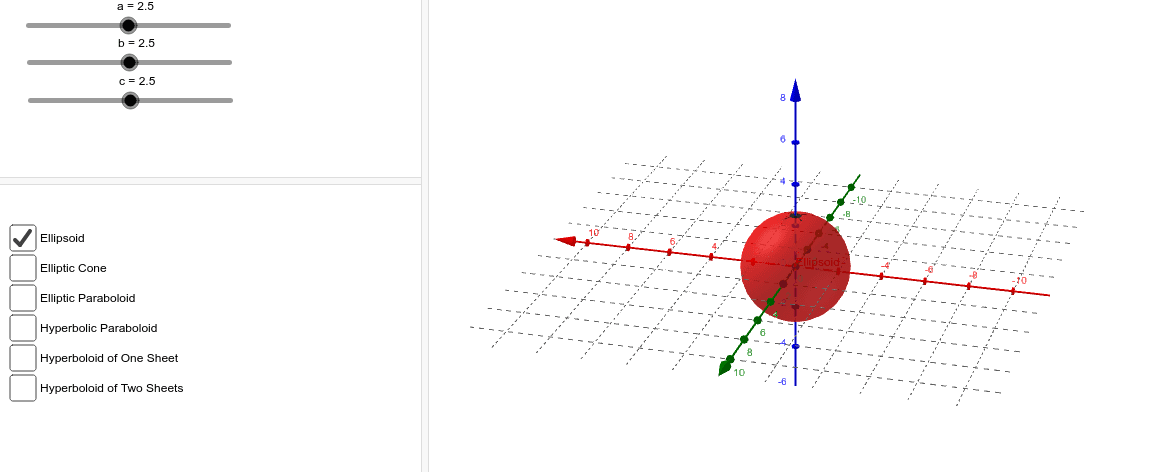
This example demonstrates common quadric surfaces including ellipsoid, elliptic cone, hyperbolic paraboloid, one-sheet hyperboloid, and two-sheet hyperboloid. It involves core math concepts like surface equations, geometric shapes, centroids, and parameter variations. The construction uses commands like Surface, Plane, and parameters a, b, c, e, f, g, h, i, j, k, along with objects such as Ellipsoid, EllipticCone, HyperbolicParaboloid, HyperboloidOneSheet, HyperboloidTwoSheetTop, HyperboloidTwoSheetBottom, and EllipticParaboloid. Suitable for high school and above students learning complex 3D geometry.
GeoGebra Commands & Parameters
Surface(((a * cos(u)) * sin(v)), ((b * sin(u)) * sin(v)), (c * cos(v)), u, 0, 6.28319, v, 0, 3.141592653589793) → EllipsoidSurface((((a * (c - w))) / c * cos(v)), (((b * (c - w))) / c * sin(v)), w, v, 0, 6.28319, w, 0, (2 * c)) → EllipticConeSurface(u, v, (u * v), u, (-a), a, v, (-b), b) → HyperbolicParaboloidSurface(((a * cosh(w)) * cos(v)), ((b * cosh(w)) * sin(v)), (c * sinh(w)), v, 0, 6.283185307179586, w, -10, 10) → HyperboloidOneSheetSurface(((a * sinh(w)) * cos(v)), ((b * sinh(w)) * sin(v)), (c * cosh(w)), v, 0, 6.283185307179586, w, 0, 100) → HyperboloidTwoSheetTopSurface(((a * sinh(w)) * cos(v)), ((b * sinh(w)) * sin(v)), ((-c) * cosh(w)), v, 0, 6.28319, w, 0, 100) → HyperboloidTwoSheetBottomPlane((-1, 0, 0), (1, 0, 0), (0, 0, 1)) → fSurface(((a * sqrt(w)) * cos(v)), ((b * sqrt(w)) * sin(v)), w, v, 0, 6.28319, w, 0, 6) → EllipticParaboloid
AI Drawing Prompt Reference
Create a 3D visualization showcasing common quadric surfaces including an ellipsoid, elliptic cone, hyperbolic paraboloid, one-sheet hyperboloid, and two-sheet hyperboloid. The ellipsoid is defined by a parametric equation, the elliptic cone arises from a slanted plane intersecting a rotating curve, and the hyperbolic paraboloid resembles a saddle. The one-sheet and two-sheet hyperboloids demonstrate upward-opening and separated forms, respectively. All surfaces share similar parameter ranges, with variations in parameters a, b, c to illustrate geometric properties.
The prompt above was compiled from the original drawing commands and is for reference only.