
Volumes: Disk Method
Loading the math board and drawing, please wait…
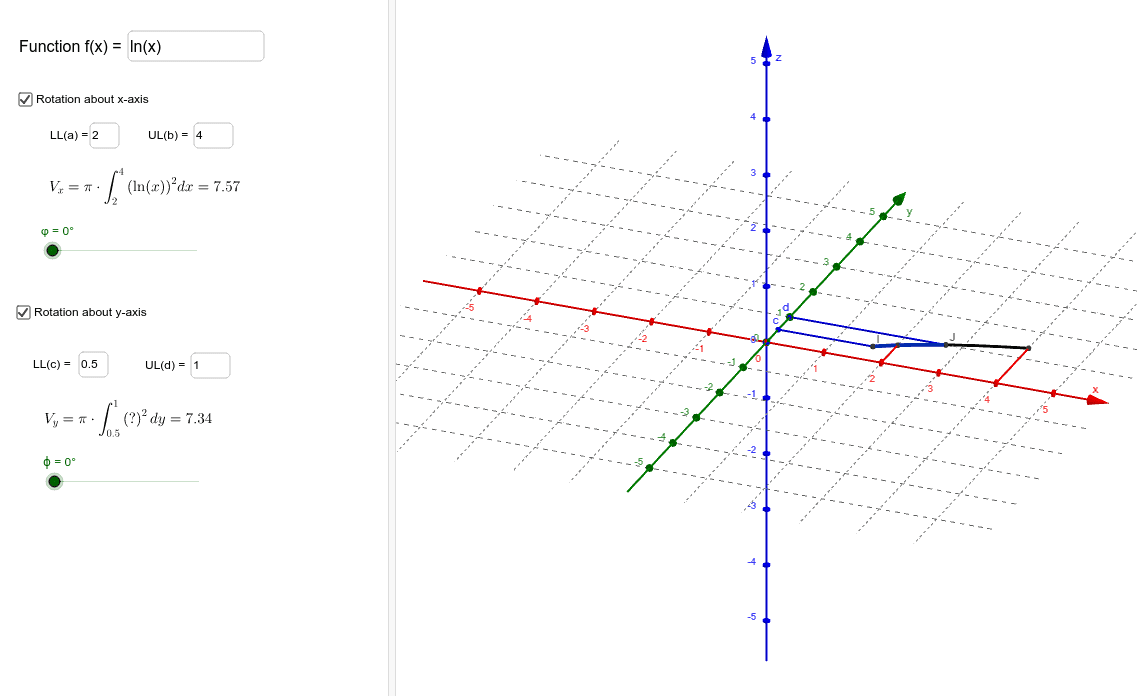
This example demonstrates how to calculate the volume of a solid of revolution using the disk method. Key mathematical concepts include integration and solid geometry. Using GeoGebra commands such as CurveCartesian, Surface, and Intersect, the solid can be constructed. Suitable for high school mathematics education and learning.
GeoGebra Commands & Parameters
Textfield(f) → FunctionTextfield(a) → Textfeld2Textfield(b) → Textfeld3CurveCartesian(t, (f(t) * cos(φ)), (f(t) * sin(φ)), t, a, b) → k_xRay((0, c), Vector[(1, 0)]) → g_1Intersect(f, g_1, (1, f(1))) → IRay((0, d), Vector[(1, 0)]) → g_2Intersect(f, g_2, (d, f(d))) → JCurveCartesian((t * cos(ϕ)), f(t), (t * sin(ϕ)), t, x(I), x(J)) → k_yCurveCartesian(t, f(t), 0, t, -5, 5) → kTextfield(c) → Textfeld4Textfield(d) → Textfeld5Segment(A, G) → s_1Segment(B, F) → s_2Surface(u, (f(u) * cos(w)), (f(u) * sin(w)), u, a, b, w, 0, φ) → f_xSurface((uu * cos(ww)), f(uu), (uu * sin(ww)), uu, x(I), x(J), ww, 0, ϕ) → f_yInvert(f) → f_uSegment(C, I) → s_3Segment(D, J) → s_4CurveCartesian(x(B), t, t, y(B), f(x(B))) → LineCapRightCurveCartesian(x(A), t, t, y(A), f(x(A))) → LineCapLeftSurface(x(A), y(A) + ((s * (f(x(A)) - y(A))) * cos(t)), ((s * (f(x(A)) - y(A))) * sin(t)), s, 0, 1, t, 0, φ) → CapLeftSurface(x(B), y(B) + ((s * (f(x(B)) - y(B))) * cos(t)), ((s * (f(x(B)) - y(B))) * sin(t)), s, 0, 1, t, 0, φ) → CapRightCurveCartesian(t, y(C), t, x(C), f_u(y(C))) → LineCapBottomCurveCartesian(t, y(D), t, x(D), f_u(y(D))) → LineCapTop
AI Drawing Prompt Reference
Draw a demonstration of calculating the volume of a solid of revolution using the disk method. Include a function curve and two perpendicular rays to the x-axis, with their intersections marked as I and J. Based on the curve and rays, sketch the surface and cross-sections of the solid, adding helper line segments and surface caps to clearly illustrate the geometric meaning of the disk method.
The prompt above was compiled from the original drawing commands and is for reference only.