
Partial Derivative Demo by Charles Reid
Loading the math board and drawing, please wait…
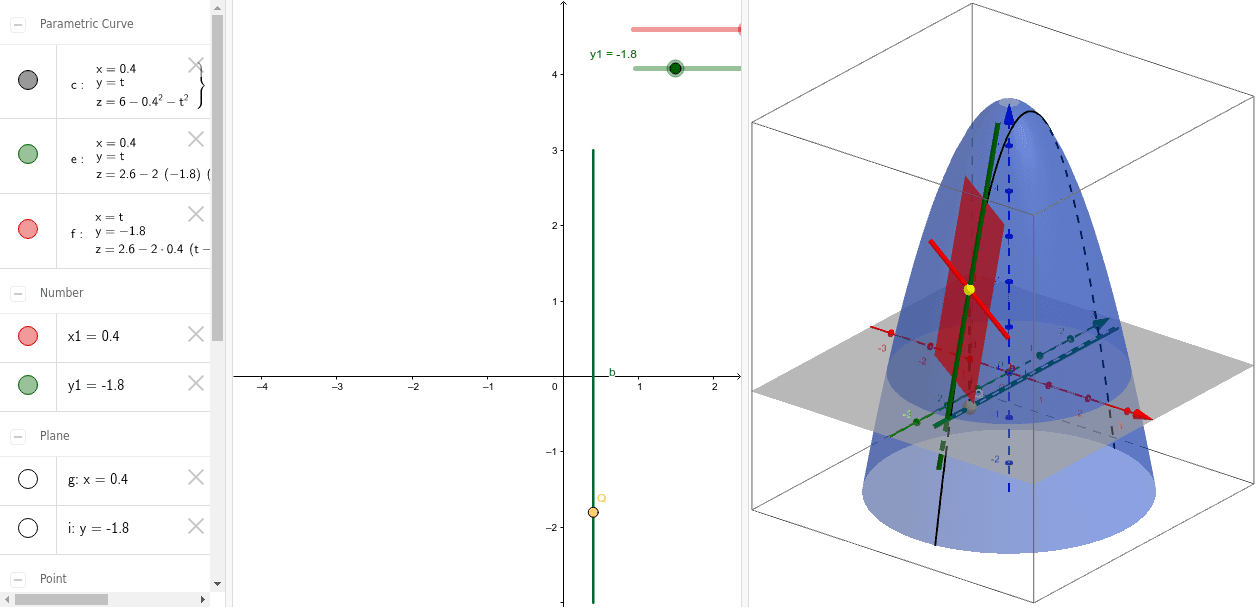
This example demonstrates the geometric meaning of partial derivatives in three-dimensional space by dynamically adjusting parameters to observe the relationship between the tangent plane and partial derivatives. Key math concepts include partial derivatives, tangent planes, multivariable functions, and spatial geometry. It uses commands like Surface, Segment, and CurveCartesian in GeoGebra, with objects such as x1, y1, P, a, Q, d, c, b, h, f, e, g, i. Suitable for high school students and beginners in calculus to explore the connection between partial derivatives and spatial geometry.
GeoGebra Commands & Parameters
Surface(u, v, 6 - u^(2) - v^(2), u, -3, 3, v, -3, 3) → aSegment(P, Q) → dCurveCartesian(x1, t, 6 - x1^(2) - t^(2), t, -3, 3) → cSegment((x1, -3), (x1, 3)) → bSurface(u, v, z(P) - ((2 * x1) * (u - x1)) - ((2 * y1) * (v - y1)), u, x1 - 0.5, x1 + 0.5, v, y1 - 0.5, y1 + 0.5) → hCurveCartesian(t, y(P), z(P) - ((2 * x1) * (t - x1)), t, x1 - 1, x1 + 1) → fCurveCartesian(x(P), t, z(P) - ((2 * y1) * (t - y1)), t, y1 - 1, y1 + 1) → e
AI Drawing Prompt Reference
Please draw a figure that demonstrates the geometric meaning of partial derivatives in three-dimensional space. First, create a surface function z = 6 - u^2 - v^2, where both u and v range from -3 to 3. Then, select a point P on this surface and draw a line segment from point P to another point Q. Next, create a curve c which is the function z = 6 - x1^2 - t^2 when x1 = t, with t ranging from -3 to 3. Draw a vertical line segment b connecting points (x1, -3) and (x1, 3). Finally, create a tangent plane h at point P that shows the geometric meaning of partial derivatives. This figure is suitable for high school students and beginners in calculus to understand the connection between partial derivatives and spatial geometry.
The prompt above was compiled from the original drawing commands and is for reference only.