
Pythagorean Theorem with Irrational Sides
Loading the math board and drawing, please wait…
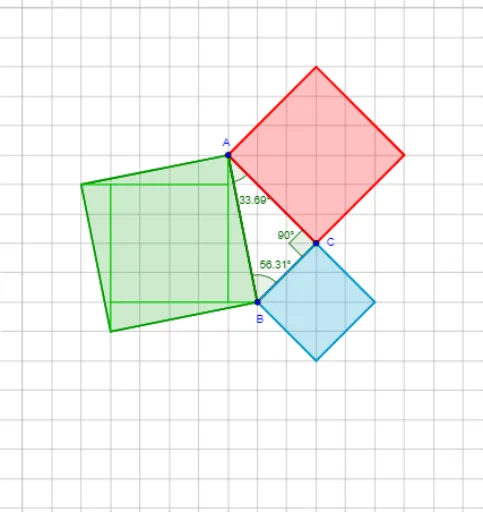
This example demonstrates the Pythagorean Theorem in right triangles with irrational side lengths. Key mathematical concepts include the theorem, trigonometric functions, and geometric construction. The construction uses GeoGebra commands such as Segment, Polygon, Angle, and Intersect to create triangles and calculate side lengths. Suitable for high school students or math enthusiasts learning geometric principles and tool usage.
GeoGebra Commands & Parameters
Segment(A_1, B_1) → fSegment(A_1, B_1) → qTextfield(empty1) → ΕισΑΒ2Textfield(empty2) → ΕισAC2Textfield(empty3) → ΕισBC2Textfield(empty5) → ΕισAC2kaiBC2SelectedElement(L) → text5SelectedIndex(L) → vSelectedIndex(L1) → wPolygon(C, A, B) → poly1, b, c, a_1Angle(poly1) → α, β, γPolygon(A, C, 4) → poly2, d, e, g, h, D, EPolygon(C, B, 4) → poly3, i, j, k, l, F, GPolygon(B, A, 4) → poly4, m, n, p, r, H, IIf(ans1 ≟ 16, true, false) → AB2If(ans2 ≟ 8, true, false) → AC2If(ans5 ≟ 16, true, false) → AC2kaiBC2If(ans3 ≟ 8, true, false) → BC2Segment(J, A) → aPoint(a) → KIntersect(n, p) → MSegment(K, M) → sPoint(s) → NIntersect(p, r) → OSegment(N, O) → tPoint(t) → PPoint(r) → QSegment(P, Q) → b_1