
Pythagorean Theorem (Right Triangles with Irrational Sides) Interactive Demo
Loading the math board and drawing, please wait…
In collections
Pythagorean Theorem
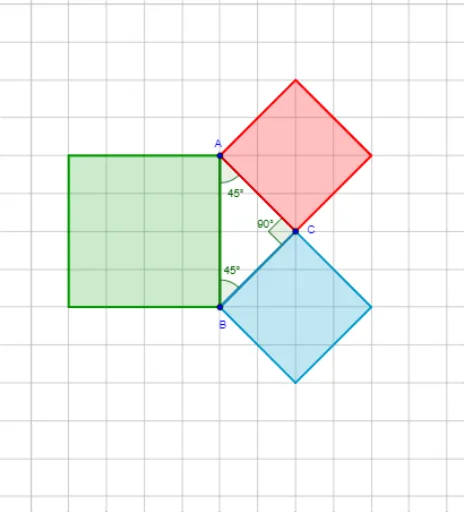
This GeoGebra example demonstrates the Pythagorean theorem in right triangles, with a special focus on cases where side lengths are irrational numbers (e.g., √2, √3). It visually verifies that the area of the square on the hypotenuse equals the sum of areas of squares on the other two sides. Core mathematical concepts include the Pythagorean relation (a²+b²=c²), geometric representation of irrational lengths, and area conservation. The construction uses Segment and Polygon to build the triangle and squares on each side, Angle to ensure right angles, and Textfield, SelectedElement, SelectedIndex for interactive input of side lengths. Conditional statements (If) and a button (button1) dynamically update the figure and computed results. This resource is suitable for middle school to high school students learning the Pythagorean theorem and irrational numbers, and can be used in math labs or inquiry-based activities to connect geometric intuition with algebraic formulas.
GeoGebra Commands & Parameters
Segment(A_1, B_1) → fSegment(A_1, B_1) → qTextfield(empty1) → ΕισΑΒ2Textfield(empty2) → ΕισAC2Textfield(empty3) → ΕισBC2Textfield(empty5) → ΕισAC2kaiBC2SelectedElement(L) → text5SelectedIndex(L) → vSelectedIndex(L1) → wPolygon(C, A, B) → poly1, b, c, a_1Angle(poly1) → α, β, γPolygon(A, C, 4) → poly2, d, e, g, h, D, EPolygon(C, B, 4) → poly3, i, j, k, l, F, GPolygon(B, A, 4) → poly4, m, n, p, r, H, IIf(ans1 ≟ 16, true, false) → AB2If(ans2 ≟ 8, true, false) → AC2If(ans5 ≟ 16, true, false) → AC2kaiBC2If(ans3 ≟ 8, true, false) → BC2
AI Drawing Prompt Reference
Draw a right triangle with one leg of length √2, the other leg of length √8, and the hypotenuse of length 4. Construct squares outward on each side of the triangle, sharing the side as one edge. Use distinct colors for the three squares and label the side lengths and areas. Include interactive input fields to change the two leg lengths, causing the figure to update dynamically and display the comparison between the square of the hypotenuse and the sum of squares of the legs, verifying the Pythagorean theorem.
The prompt above was compiled from the original drawing commands and is for reference only.