
Pythagorean Theorem for Obtuse Triangles with Irrational Sides
Loading the math board and drawing, please wait…
In collections
Pythagorean Theorem
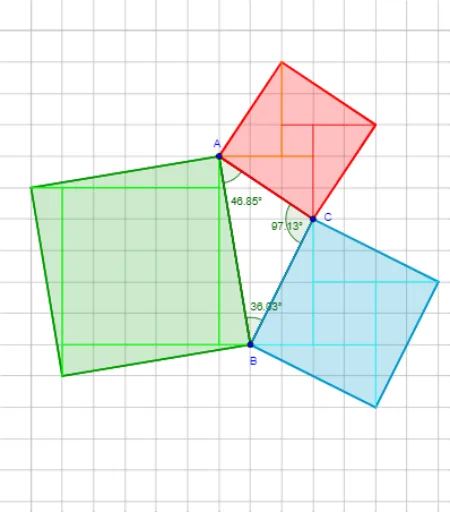
This example demonstrates the Pythagorean Theorem for obtuse triangles with irrational side lengths. It explores the relationship between the hypotenuse and the legs of an obtuse triangle by constructing a right triangle and showing that the square of the hypotenuse equals the sum of the squares of the legs. The construction uses commands such as line segment, point, angle, and intersection in GeoGebra. Suitable for middle school and above students to learn geometric construction and the Pythagorean Theorem.
GeoGebra Commands & Parameters
Segment(A_1, B_1) → fSegment(A_1, B_1) → qTextfield(empty1) → ΕισΑΒ2Textfield(empty2) → ΕισAC2Textfield(empty3) → ΕισBC2Textfield(empty5) → ΕισAC2kaiBC2SelectedElement(L) → text5SelectedIndex(L) → vSelectedIndex(L1) → wPolygon(C, A, B) → poly1, b, c, a_1Angle(poly1) → α, β, γPolygon(A, C, 4) → poly2, d, e, g, h, D, EPolygon(C, B, 4) → poly3, i, j, k, l, F, GPolygon(B, A, 4) → poly4, m, n, p, r, H, ISegment(J, A) → aPoint(a) → KIntersect(n, p) → MSegment(K, M) → sPoint(s) → NIntersect(p, r) → OSegment(N, O) → tPoint(t) → PPoint(r) → QSegment(P, Q) → b_1Intersect(g, h) → TPoint(g) → UIntersect(k, l) → VPoint(k) → WSegment(M, R) → e_1Segment(A, S) → f_1Segment(Z, B) → g_1Point(e_1) → C_1Segment(O, C_1) → h_1Segment(A, D_1) → i_1Point(i_1) → E_1Segment(T, E_1) → k_1If(ans1 ≟ 37, true, false) → AB2Segment(U, F_1) → j_1Point(j_1) → G_1Intersect(e, l) → H_1Segment(G_1, H_1) → l_1Segment(H_1, J_1) → d_1Point(d_1) → K_1Segment(G, K_1) → m_1Point(m_1) → L_1Segment(L_1, W) → n_1Point(n_1) → M_1Segment(I_1, M_1) → c_1If(ans2 ≟ 13, true, false) → AC2If(ans5 ≟ 33, true, false) → AC2kaiBC2If(ans3 ≟ 20, true, false) → BC2