
Pythagorean Theorem for Acute Triangles with Irrational Sides
Loading the math board and drawing, please wait…
In collections
Pythagorean Theorem
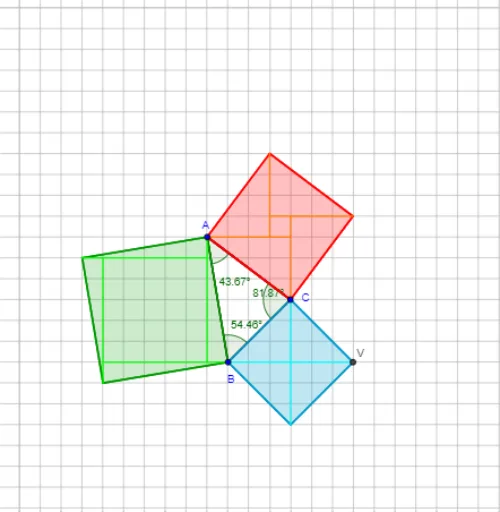
This example demonstrates the Pythagorean theorem for acute triangles, involving irrational side lengths. Using GeoGebra commands such as Segment, Textfield, Polygon, etc., it illustrates the application of the Pythagorean theorem in acute triangles. Suitable for middle school and above students to learn geometric construction and the Pythagorean theorem.
GeoGebra Commands & Parameters
Segment(A_1, B_1) → fSegment(A_1, B_1) → qTextfield(empty1) → ΕισΑΒ2Textfield(empty2) → ΕισAC2Textfield(empty3) → ΕισBC2Textfield(empty5) → ΕισAC2kaiBC2SelectedElement(L) → text5SelectedIndex(L) → vSelectedIndex(L1) → wPolygon(C, A, B) → poly1, b, c, a_1Angle(poly1) → α, β, γPolygon(A, C, 4) → poly2, d, e, g, h, D, EPolygon(C, B, 4) → poly3, i, j, k, l, F, GPolygon(B, A, 4) → poly4, m, n, p, r, H, ISegment(J, A) → aPoint(a) → KIntersect(n, p) → MSegment(K, M) → sPoint(s) → NIntersect(p, r) → OSegment(N, O) → tPoint(t) → PPoint(r) → QSegment(P, Q) → b_1Intersect(g, h) → TPoint(g) → UIntersect(k, l) → VPoint(k) → WSegment(C, W) → c_1Segment(B, V) → d_1Segment(M, R) → e_1Segment(A, S) → f_1Segment(Z, B) → g_1Point(e_1) → C_1Segment(O, C_1) → h_1Segment(A, D_1) → i_1Point(i_1) → E_1Segment(T, E_1) → k_1Point(k_1) → F_1Segment(F_1, U) → l_1Point(l_1) → G_1Segment(G_1, C) → j_1If(ans1 ≟ 37, true, false) → AB2If(ans2 ≟ 25, true, false) → AC2If(ans5 ≟ 43, true, false) → AC2kaiBC2If(ans3 ≟ 18, true, false) → BC2