
Properties of Parallel Lines and Transversals
Loading the math board and drawing, please wait…
In collections
Euclidean Geometry
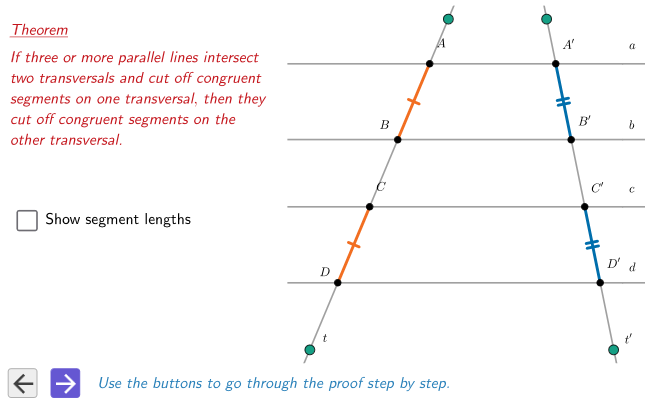
This example demonstrates an important theorem about parallel lines cut by transversals through step-by-step proof and exploration. It involves properties of parallel lines, transversals, and segments, using GeoGebra commands such as point, polygon, line, intersect, segment, and angle. Suitable for middle school and above students and teachers to understand geometric constructions and related concepts.
GeoGebra Commands & Parameters
Point(xAxis) → PEEPSTPolygon({PP1, PP2, PP3, PP4}) → peepPoint(Sequence[(k, -3.7), k, -3.5, -0.5, 0.2]) → T11Point(Sequence[(k, -3.7), k, 0.5, 3.5, 0.2]) → T21Point(Sequence[(k, 3.7), k, -3, -0.4, 0.2]) → T10Line(T10, T11) → t1Point(Sequence[(k, 3.7), k, 0.4, 3, 0.2]) → T20Line(T20, T21) → t2Intersect(ra, t1) → AIntersect(rb, t1) → BIntersect(rc, t1) → CIntersect(rd, t1) → DIntersect(ra, t2) → A'Intersect(rb, t2) → B'Intersect(rc, t2) → C'Intersect(rd, t2) → D'Segment(A, B) → segmABSegment(A', B') → segmAB'Segment(C', D') → segmGreyCD'Segment(A', B') → segmGreyAB'Segment(C, D) → segmCDSegment(C', D') → segmCD'Line(A, t2) → parAt'Line(C, t2) → parCt'Intersect(parAt', rb) → ESegment(A - (0.5 * UnitVector[parAt']), E + (0.5 * UnitVector[parAt'])) → segmLongAEIntersect(parCt', rd) → FSegment(C - (0.5 * UnitVector[parAt']), F + (0.5 * UnitVector[parAt'])) → segmLongCFPolygon({A, B, E}) → trABEPolygon({C, D, F}) → trCDFAngle(B, A, E) → angBAEAngle(E, B, A) → angABEAngle(D, C, F) → angDCFAngle(F, D, C) → angCDFSegment(A, E) → segmAESegment(C, F) → segmCFPolygon({A, A', B', E}) → quadAEPolygon({C, C', D', F}) → quadCF
AI Drawing Prompt Reference
Draw two parallel horizontal lines as transversals, one above and one below, intersecting four vertical parallel lines to create two sets of intersection points. On each transversal, select adjacent points to form segments, and connect corresponding upper and lower points to create two triangles. Then, through parallel constructions, make one side of each triangle parallel to the other transversal, and mark the relevant angles. Finally, connect points with polygons to form two quadrilaterals, illustrating the properties of parallel lines cut by transversals, such as equal corresponding angles and proportional segments.
The prompt above was compiled from the original drawing commands and is for reference only.