
Escher-Style Angles & Circle Construction: Symmetric Angle Chasing
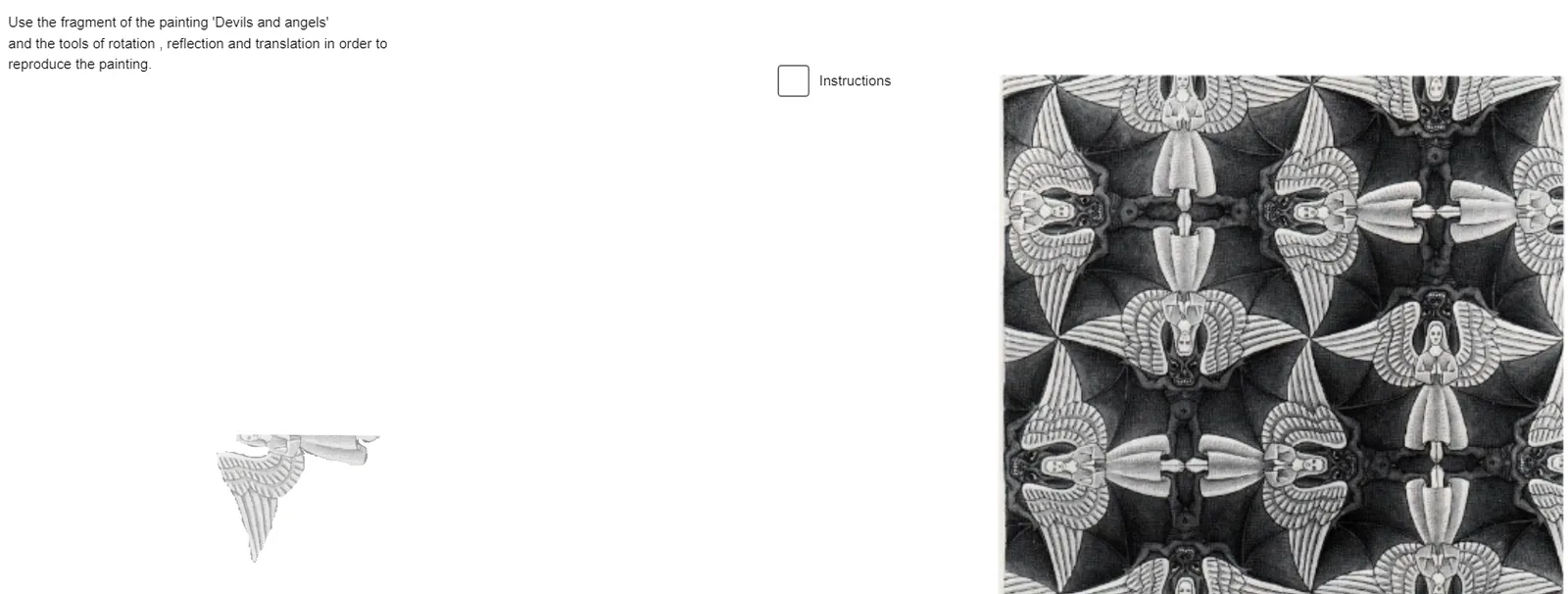
Loading the math board and drawing, please wait…
This GeoGebra example uses an Escher-like layout to visually demonstrate how angle relationships can be propagated through a geometry construction while preserving symmetry under circle constraints. It focuses on key concepts such as measuring and chasing angles, using circle geometry (circumcircle / circumscribed circle), identifying special points (notably intersection and key circle/line points), and maintaining symmetry-driven invariants throughout the construction. From the construction summary, a network of points (A, B, C, D, then E–J and others) forms the geometric framework; pic1–pic6 provide staged/variant visualizations; text1–text3 and text2 label crucial points or angle measures; and indexed objects like B_1, A_1, C_1, D_1, E_1 together with the scalar/parameter-like entry a indicate repeated corresponding constructions (e.g., mirrored or congruent angle setups). Suitable for secondary-level geometry enrichment, competition geometry intuition-building, and classroom GeoGebra construction demonstrations.
GeoGebra Commands & Parameters
Point A(-10.302622002840613, 0.8668587667548937)Point B(-9.035258472062436, 0.8668587667548937)Point C(-2.807543061723724, -1.47252553841648)Point D(-1.9255574763069725, -1.6015116580063986)Point E(-2.2658745644599243, -2.0388153310104515)Point F(-1.5808593416845547, -1.9462097926288162)Point G(-2.2658745644599243, -2.0388153310104515)Point H(-0.6101254355400629, -2.0388153310104515)Point I(-0.9332865555557701, -2.4719771032245554)Point J(0.6788319495527884, -2.4719771032245554)Point K(-3.1270766884193963, 3.578808879461935)Point L(5.436209827414659, 3.51971777066952)Point M(-3.2501831650702617, 3.307974630830034)Point N(5.066890397462075, 3.224262226707446)Point O(-3.2255618697400923, 4.120477376725731)Point P(5.4608311227448425, 4.18449274458418)Point Q(-2.9793489164383606, 3.5788088794619326)Point R(4.6975709675094866, 3.6428242473203816)Point S(-2.536165600495254, 3.578808879461933)Point T(4.623707081518965, 3.642824247320382)Point U(-3.200940574409917, 3.6034301747921056)Point V(5.042269102131898, 3.34736870335831)Point W(9.038735229851667, -0.36977692427790193)Point Z(21.739080494494942, -0.3943423890064188)Boolean a(false)Point B_1(-3.98648761725317, -2.532832773737537)Point A_1(-8.187647121601795, 1.1083450631672536)Point C_1(-4.134345441396485, 1.1083450631672536)Point D_1(-8.560922353939993, 0.8278194391211185)Point E_1(-4.870111067899378, 0.796183913812199)
AI Drawing Prompt Reference
Draw an Escher-style geometric figure with multiple points A, B, C, D, E, F, G, H, I, J, K, L, M, N, O, P, Q, R, S, T, U, V, W, Z, and points B_1, A_1, C_1, D_1, E_1. Points A, B, C, D, E, F, G, H, I, J form the basic framework, while points K, L, M, N, O, P, Q, R, S, T, U, V, W, Z are auxiliary points. Points B_1, A_1, C_1, D_1, E_1 are symmetrically constructed based on points A, B, C, D, E. The entire figure maintains symmetry and uses circle properties to construct angle relationships.
The prompt above was compiled from the original drawing commands and is for reference only.