
Geometric “Anatomy” Construction for a Logarithmic Function
Loading the math board and drawing, please wait…
In collections
Graphing Logarithmic Functions
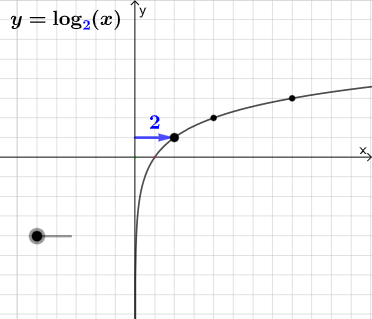
This example demonstrates, via geometric construction, how to dissect a logarithmic function’s key behavior by translating log relationships into proportional length changes inside a similarity-based configuration. The core ideas are logarithmic functions, graphing/visual interpretation, and using similar triangles (and related proportional reasoning) to connect algebraic log rules with measurable geometric quantities. Construction-wise, the GeoGebra commands highlighted by the construct summary are Point, Intersect, and Vector: points and intersection objects (e.g., the various named points such as g, h, A, B, C, D, E, F, G, H, I, J) define the framework, while Vector helps encode direction/scale relationships needed to represent the functional correspondence. Additional objects like eq1 and multiple labeled items (e.g., k, k_{1}, k1, and text annotations) are used to express constraints and display the derived relationships on the figure. Suitable for high school to early college lessons on functions, geometric construction, and using models to build intuition about logarithms and their graphical behavior.
GeoGebra Commands & Parameters
Point(Ray[B + (1, 1), B + (2, 1)]) → CPoint(Ray[B + (1, -1), B + (2, -1)]) → DIntersect(xAxis, yAxis) → GVector(G, A) → uVector(H, B) → vIntersect(eq1, y = y(C)) → IIntersect(eq1, y = y(D)) → JVector(I, C) → wVector(J, D) → j
AI Drawing Prompt Reference
Draw a geometric figure to illustrate the behavior of a logarithmic function. Use similar triangles and proportional relationships to transform logarithmic relationships into length changes. The figure includes points, line segments, and vectors to represent the correspondence of the logarithmic function. The construction order starts from basic points, then connects them using vectors and intersection points, forming a graphical representation of the logarithmic function.
The prompt above was compiled from the original drawing commands and is for reference only.