
Pythagorean Theorem Extension
Loading the math board and drawing, please wait…
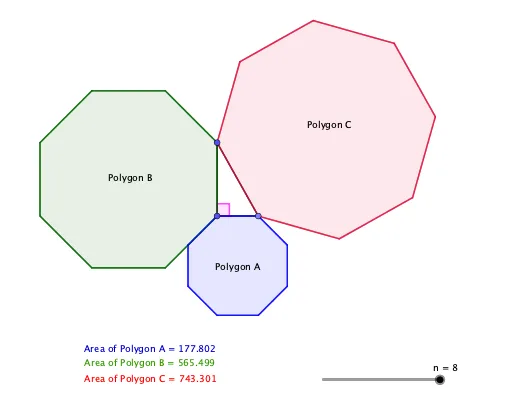
This GeoGebra applet demonstrates the relationship among regular polygons containing the sides of a right triangle. It involves the core concept of the Pythagorean Theorem and constructs regular polygons, angles, and centroids using commands like Segment, OrthogonalLine, Point, Polygon, Angle, and Centroid. Suitable for middle school and above students to learn geometry and the Pythagorean Theorem.
GeoGebra Commands & Parameters
Segment(A, B) → fOrthogonalLine(B, f) → gPoint(g) → CSegment(B, C) → hSegment(A, C) → iPolygon(A, C, n) → poly1, j, t_1, D, G, J, M, P, S, V, A_1, k, l, a, d, g_1, j_1, m_1, q_1Polygon(B, A, n) → poly2, m, a_1, E, H, K, N, Q, T, W, B_1, p, q, b, e, h_1, k_1, n_1, r_1Polygon(C, B, n) → poly3, r, b_1, F, I, L, O, R, U, Z, C_1, s, t, c, f_1, i_1, l_1, p_1, s_1Angle(A, B, C) → αCentroid(poly2) → D_1Centroid(poly3) → E_1Centroid(poly1) → F_1
AI Drawing Prompt Reference
Draw a horizontal segment as one leg of a right triangle. At one endpoint, construct a perpendicular line and pick a point on it, then connect this point to both endpoints to form the right triangle. On each side of the triangle, construct a regular polygon (all with the same number of sides) outward, so that each polygon shares one side with the triangle. Mark the right angle at the vertex, and locate the centroid of each polygon, labeling them as points. The figure illustrates the extended Pythagorean theorem relating the areas of regular polygons built on the sides of a right triangle.
The prompt above was compiled from the original drawing commands and is for reference only.