
Properties of a Square by David T
Loading the math board and drawing, please wait…
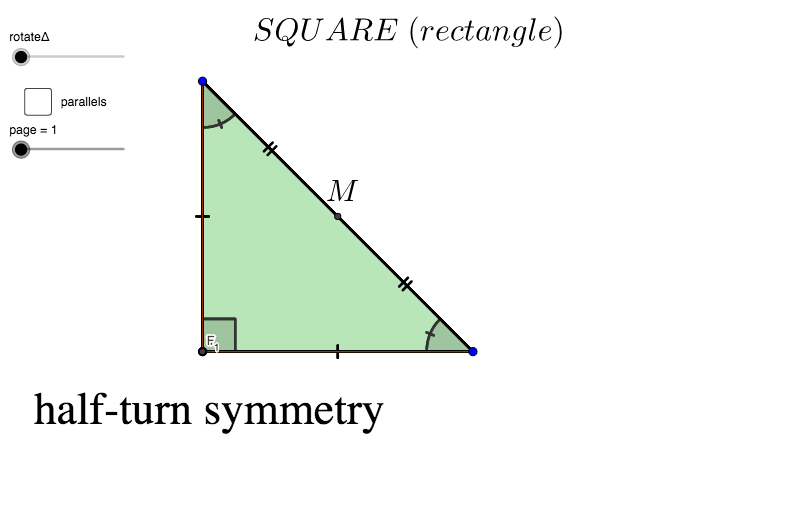
This example demonstrates the properties of a square, including equal and perpendicular diagonals, equal sides, and all interior angles of 90 degrees. Key mathematical concepts include geometric construction, segments, angles, and rotation. Using GeoGebra commands such as Circle, Line, OrthogonalLine, Segment, Intersect, Polygon, Midpoint, and Rotate, the example dynamically illustrates the properties of a square. Suitable for students in middle school and above to learn geometric construction and related properties.
GeoGebra Commands & Parameters
Circle(A, B) → pLine(A, B) → e_1OrthogonalLine(A, e_1) → iSegment(A, B) → d_1Intersect(p, i) → D, CPolygon(A, D, B) → P, a, b, dMidpoint(D, B) → ERotate(A, (-rotateΔ), E) → A'Rotate(D, (-rotateΔ), E) → D'Rotate(B, (-rotateΔ), E) → B'Polygon(A', D', B') → P', c, e, fOrthogonalLine(B, e_1) → f_3Intersect(f_3, e_1) → FMidpoint(B', A') → GIf(rotateΔ > 0°, G) → KMidpoint(d_1) → MAngle(B', A', D') → γAngle(B, A, D) → δAngle(D, B, A) → ζAngle(D', B', A') → αAngle(A, D, B) → βAngle(A', D', B') → εSegment(D', A') → c_1Segment(A, D) → a_1Segment(B', A') → f_1Segment(A, D) → a_2Segment(D', A') → c_2Segment(B', A') → f_2Segment(A, B) → d_2Segment(D, E) → gSegment(B, E) → g_1Segment(A, E) → hSegment(A', E) → h_1Angle(E, A, D) → ηAngle(B, A, E) → θAngle(D, A', E) → ιAngle(E, A', B) → κAngle(A, D, A') → λAngle(A', B, A) → μLine(E, e_1) → jLine(E, f_3) → kPoint(j) → LPoint(j) → NPoint(k) → OPoint(k) → QSegment(O, Q) → lSegment(L, N) → mIntersect(p, i, 2) → ILine(A, E) → qPoint(q) → HPoint(q) → JSegment(H, J) → sPolygon(A, D, A', B) → P'', a_3, d_3, a', b_1Rotate(A, turn, E) → A'_1Rotate(D, turn, E) → D'_1Rotate(A', turn, E) → A''Rotate(B, turn, E) → B'_1Rotate(A, (-turn), E) → A'_2Rotate(D, (-turn), E) → D'_2Rotate(A', (-turn), E) → A''_1Rotate(B, (-turn), E) → B'_2Polygon(A'_2, D'_2, A''_1, B'_2) → P''', a'_2, d'_2, a''_1, b'_2Angle(D, E, A) → νLine(E, D) → nPoint(n) → RPoint(n) → SSegment(R, S) → rPolygon(A, D, A', B) → polyfold, a_4, d_4, a'_1, b_2LineBisector(drag, A') → tIntersect(t, f) → UIntersect(c, a'_1) → VIntersect(t, c) → WPolygon(U, drag, W) → poly1, w, u, t_1Intersect(t, a) → ZOrthogonalLine(drag, u) → i_1Line(Z, u) → j_1Intersect(i_1, j_1) → A_1Polygon(W, drag, A_1, Z) → poly2, w_1, t_2, a_5, zOrthogonalLine(drag, w) → k_1Intersect(t, d) → B_1Line(B_1, w) → l_1Intersect(k_1, l_1) → C_1Polygon(U, drag, C_1, B_1) → poly3, u_1, t_3, c_3, b_3LineBisector(peel, B) → m_1Intersect(m_1, c) → D_1Intersect(m_1, d) → E_1Polygon(peel, E_1, D_1) → poly4, d_5, t_4, e_2Intersect(f, d_4) → F_1Intersect(m_1, f) → G_1OrthogonalLine(peel, d_5) → n_1Line(G_1, d_5) → p_1Intersect(n_1, p_1) → H_1Polygon(peel, E_1, G_1, H_1) → poly5, t_5, e_3, g_2, h_2Intersect(m_1, a) → I_1OrthogonalLine(peel, e_2) → q_1Line(I_1, e_2) → r_1Intersect(r_1, q_1) → J_1Polygon(peel, D_1, I_1, J_1) → poly6, t_6, d_6, i_2, j_2
AI Drawing Prompt Reference
Draw a square with its diagonals and sides, including all angles. Start by drawing a circle and a line, then construct the two diagonals of the square, draw the sides, and rotate the square. Finally, label all angles and ensure the diagonals are equal and perpendicular.
The prompt above was compiled from the original drawing commands and is for reference only.