
3D Cuboid and the 3D Pythagorean Theorem
Loading the math board and drawing, please wait…
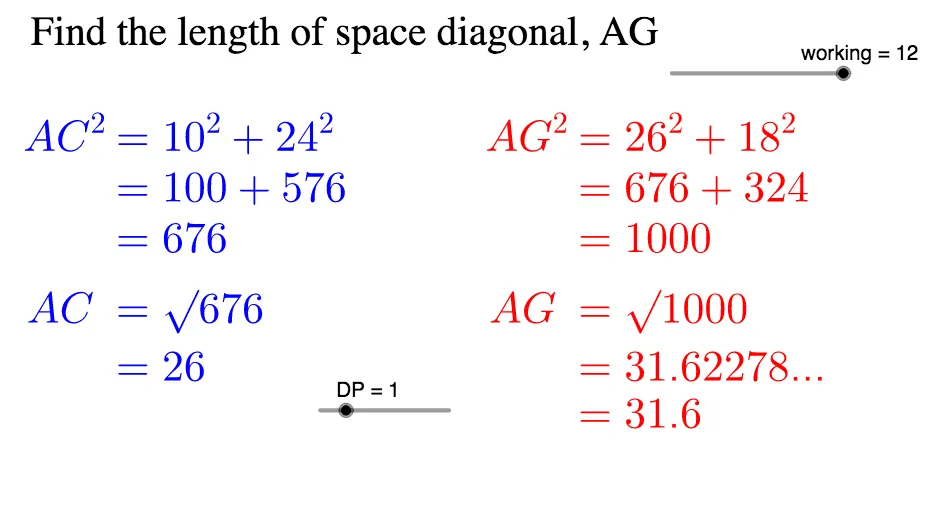
This GeoGebra example visualizes the 3D Pythagorean relationship in a cuboid: given its length, width (breadth), and height, it computes/illustrates how the space diagonal length is determined by the three perpendicular dimensions. It emphasizes the underlying structure from right triangles and extends the familiar 2D Pythagorean Theorem to three dimensions. The construction uses core geometry tools—Point, Segment, Polygon, Vector, and Midpoint—to place vertices, draw edges and key diagonals, form relevant faces, and represent diagonal directions whose magnitudes correspond to the needed distances. Dimension parameters such as length/height/breadth are adjustable, while Move and scale support dynamic exploration, helping learners verify the theorem visually and understand the metric dependency of the diagonal. Suitable for middle/high school solid geometry, vector/length intuition, and classroom demonstrations or self-study.
GeoGebra Commands & Parameters
Vector(E_1, B_1) → uVector(E_1, C_1) → vVector(E_1, D_1) → wSegment(D, A) → tSegment(C, D) → sSegment(G, C) → iSegment(C, B) → jSegment(B, F) → kSegment(F, G) → l_1Segment(G, H) → m_2Segment(H, E) → n_1Segment(F, E) → pSegment(E, A) → qSegment(A, B) → rSegment(D, H) → a_1Polygon(A, G, C) → poly1, o, m_1, h_1Segment(A, G) → b_1Polygon(A, C, D) → poly2, k_1, d_1, o_1Point(s) → H_1Point(i) → LPoint(t) → A_1Midpoint(t) → MMidpoint(s) → QMidpoint(i) → RMidpoint(h_1) → I
AI Drawing Prompt Reference
Draw a 3D cuboid with one base vertex as the origin. Create three vectors along the three perpendicular edges representing length, width, and height. Connect all vertices with line segments to form the cuboid's edges. Draw the space diagonal from the origin to the opposite top vertex, and also draw face diagonals on the base and side faces. Highlight two triangular polygons: one formed by the origin, the opposite base vertex, and the opposite top vertex; the other formed by the origin, an adjacent base vertex, and the opposite base vertex. Place midpoints on several edges and points on the space diagonal and a base edge for reference. The overall figure should clearly illustrate the 3D Pythagorean theorem structure.
The prompt above was compiled from the original drawing commands and is for reference only.